


Sensory toys for children: advantages, examples & tips [2026]

Sensory toys for children: What really promotes development – and what you should pay attention to.
Which sensory toys do children really need? Which senses are stimulated? What does current research say? A guide from infancy to primary school age.

How old is your child?
Jump directly to the appropriate age recommendation:

Imagine your child immersed in a fascinating world of crackling textures, soft sounds and vibrant colors – grasping, pouring and discovering, with eyes wide open in wonder.
No instructions needed, just pure curiosity. As a mother of two and founder of Flowfull®, I experience these magical flow moments every day. They are the spark that ignites a child's development.
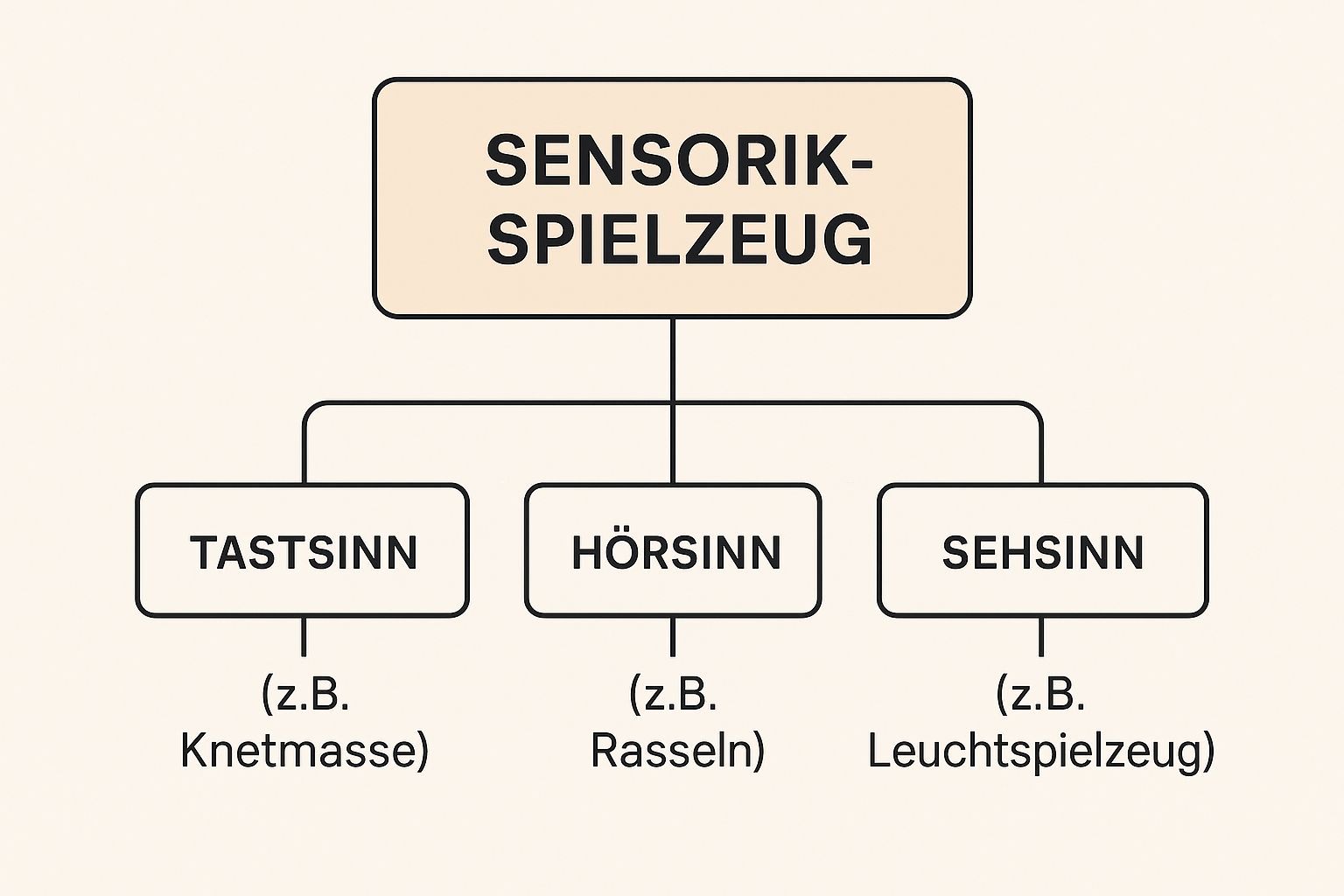
Sensory toys are more than just play: they are a targeted key to the world that appeals to the five senses – touch, sight, hearing, smell and taste.
In this guide, I share practical tips and examples for parents, educators, and therapists.
Why playing with the senses is so crucial
But what exactly makes a good sensory toy – and which one is right for your child?
Between the ages of 3 and 6, the brain develops neural connections – every sensory experience is a building block for future abilities. Sensory play not only promotes enjoyment but also creates a stable foundation.
Imagine this: Your child reaches into a box containing different materials – they not only learn to distinguish textures, but also practice patience, observation, and problem-solving. Studies show that such activities stimulate cognitive development and can even reduce the risk of learning difficulties.
What the research says: A study from the University of Virginia (Lillard et al., 2017) with 141 preschool children showed that children who worked with sensory-rich materials achieved significantly better results in reading comprehension, mathematics, and social cognition. → To the study (Frontiers in Psychology)

"It is the work of childhood – playfully understanding the world and finding emotional balance."
In a time when children are often surrounded by screens, sensory toys offer a welcome alternative: They stimulate natural curiosity and help to avoid overstimulation.
It is used particularly in kindergartens or therapies to promote group activities or to address individual needs, such as in the case of sensory processing disorders.
That is precisely why more and more occupational therapists are specifically recommending sensory toys for use at home – as a simple but effective addition to everyday life.
You can learn more about the basics in our article on sensory integration in children.
What exactly is a sensory toy?
Unlike classic toys (e.g., puzzles with a fixed goal), sensory toys are "open-ended": They invite free exploration without rules and are based on sensory integration – the brain's ability to connect stimuli.
Good sensory toys always appeal to several senses simultaneously – tactile, visual and sometimes auditory stimuli merge into a holistic sensory play experience.
A child digging in sand feels the cold, hears the rippling sound, and feels the sun – all of which trains the nervous system. Examples range from tactile balls and sound toys to scent sets, always with a focus on sensory experience.
It differs from traditional toys in its open-ended nature: there is no "right" or "wrong", but pure discovery that awakens curiosity and intrinsically motivates learning.
The trend is growing: In Germany, families invest millions annually in such toys because they are sustainable and versatile. They fit perfectly with Montessori principles, where children learn independently, and are recommended in modern educational approaches.
Sensory toys also help to identify and address sensory deficits early on, which is increasingly being used in schools and occupational therapy practices.

Our Flowfull sensory cube basin with creative wooden cubes offers exactly that: Soft, round and suitable for ages 3 and up: Children immerse themselves in a tactile experience with creative wooden cubes (1×1 cm) – ideal for grasping, pouring and sorting.
Open-ended play materials promote fine motor skills, concentration, and sensory perception – ideal for homes, kindergartens, and practices. Creative play reimagined with our Flowfull® cube basin.
The crucial difference to normal toys
- Process rather than goal: The fun lies in the experience – pouring, feeling, experimenting – not in completion, which boosts creativity and minimizes frustration.
- Focus on the senses: Specifically for textures (e.g., soft vs. hard), sounds, or colors to sharpen perception and activate multisensory learning processes.
- Self-initiative: Children decide for themselves, which strengthens self-confidence and teaches problem-solving, unlike structured toys.
✦ Sensory toys
🪵 Natural materials: wood, fabric, felt
🔓 Open game without "right" or "wrong"
🎯 Specifically designed for sensory experiences
🧠 Child determines pace & direction
♻️ Playable for years, grows with you
Conventional toys
🔌 Often plastic with electronics
🔒 Fixed gameplay sequence
📢 Many stimuli at once (light + sound)
👆 Push-button entertainment
⏳ Often quickly becomes uninteresting
These connections are the foundation for:
- Language development: Children learn to put their perceptions into words: "That is soft" or "That smells sweet!".
- Problem-solving skills: Free experimentation with materials trains logical thinking all by itself.
- Social interaction: Shared sensory play promotes communication and empathy.
Sensory play is the real work of childhood. It is far more than just play; it is how children understand the world and how it works. By providing them with diverse sensory experiences, we give them the best tools for healthy development.
The advantages of sensory toys
Sensory toys nourish the brain and support holistic development:
- Fine motor skills: Grasping and pouring train muscles used for writing and everyday skills. High-quality wooden sensory toys offer particularly natural tactile stimuli.
- Concentration: Immersive play promotes focus, reduces distractions and helps with ADHD through calming stimuli.
- Language: New sensations expand the vocabulary – “scratchy” or “smooth” become tangible and make communication more lively.
- Emotional regulation: Calms through rhythmic activities, reduces stress and promotes balance.
- Creativity & Social Skills: Open play stimulates imagination; in groups, one learns to share and communicate.
- For autism/ADHD: Helps filter stimuli and regulate the nervous system, for better integration and emotional stability.
Sensory toys by age: What's suitable when?
Not every sensory toy is suitable for every age. Sensory development occurs in phases – and each phase requires different stimuli. Here's a guide:
0–12 months: First sensory experiences
Even babies benefit from targeted sensory stimuli. In the first few months, it's all about basic experiences: contrasting black and white images stimulate visual development, wooden rattles train hand-eye coordination, and soft fabric balls invite grasping.
Suitable sensory toys: contrast pictures, wooden teething ring, fabric ball, simple rattle, crinkle book. Everything must be large enough so that it cannot be swallowed.
1–3 years: The discovery phase
Toddlers discover the world through repetition. Stacking, pegging, pouring, emptying and filling – over and over again. That's exactly what they need: sensory toys that allow for this repetition and offer different textures.
Suitable sensory toys: wooden stacking tower, touch-and-feel books with different textures, water play table, playdough, simple pouring exercises with large containers. From about 2 years: first sensory boxes with rice or lentils.
3–5 years: The sensory sweet spot
From the age of 3, the most intensive phase for sensory play begins. Children sort, categorize, experiment – and can occupy themselves independently for 30–60 minutes with the right materials. During this phase, the brain massively develops neural connections.
Suitable sensory toys: Sensory play systems such as the Flowfull® cube basin with wooden cubes, sorting games, kinesthetic sand, sandpaper letters, and pouring exercises with small containers. At this stage, sensory toys demonstrate their full effect on concentration, fine motor skills, and emotional regulation.
Current research (2025): The largest national study to date (Lillard et al., 588 children, 24 programs) shows that children working with open-ended, sensory materials achieve significantly better learning outcomes – at a lower cost. → To the PNAS study
5–7 years: In-depth study and complexity
Preschool and primary school children use sensory toys differently: They plan, build complex structures, and integrate sensory materials into imaginative play. Open-ended materials become building blocks for elaborate play worlds.
Suitable sensory toys: challenging constructions, experimental materials, tools and crafts, complex sorting materials. The Flowfull® Starter Set is ideal as a compact introduction – children can use it to build landscapes, patterns, and imaginary worlds.
Good to know: An international meta-analysis confirms the positive effects of sensory-rich learning on cognitive abilities, social skills, and academic performance – across different age groups and cultures. → To the meta-analysis
💡 Important
All age recommendations are guidelines. Every child develops at their own pace. Observe what fascinates your child at the moment – that's always the best compass for choosing the right sensory toy.

Practical examples and tips for children aged 3 and up
DIY ideas for the home: These simple activities require little material and can be done spontaneously:
- Sensory box: Fill a box with rice, lentils or pasta; pouring and burying promotes motor skills and understanding of quantities.
- Barefoot path: towel, cardboard, mat – trains sense of touch, balance and sensory perception.
- Ice cube treasure hunt: Freezing toys; freeing them teaches physics and the perception of cold.
- Sensory pouches: Hair gel with glitter in pouches – squeeze and observe to train fine motor skills without making a mess.
- Shaker bottles: Rice or water in bottles – exploring sounds strengthens hearing and creativity.
You can find even more inspiration in our article "Making your own sensory toys".

Besides DIY ideas, ready-made sensory toys, specifically designed for daily sensory play, are also worth considering:
Sorting games or wooden sets like our Flowfull Sensory Box – robust, mess-free, and versatile for everyday play, with antibacterial properties for hygiene. It grows with the child and is suitable for solo or group play.
The cube basin with thousands of creative wooden cubes – designed as a tactile toy, it combines sensory play with the Montessori principle of free exploration.
In kindergarten/therapy: Set up a "sensory corner" or plan themed days with sensory boxes. For special needs (e.g., autism), it regulates stimuli; the Flowfull box creates a safe environment for group or individual therapy.
We'll show you how to set up a sensory table in our guide to sensory table ideas.
Choosing the right sensory toy
Pay attention to:
- Safety: Free of harmful substances, age-appropriate, stable construction without splinters – essential for children.
- Sustainability: Durable wood instead of plastic, environmentally friendly and sensorially appealing.
- Open play: Versatile, so that it grows with the child and promotes creativity.
- Practicality: Easy to set up, like our Flowfull sensory box – foldable and hygienic.
Conclusion: Sensory toys are an investment in the future.
Sensory toys promote motor skills, concentration, language, emotional balance, creativity and social skills – a foundation for life.
In a digital world, it offers haptic experiences that are essential for healthy development and helps prevent future challenges such as learning disabilities.
Whether homemade or as a well-designed sensory toy system like Flowfull® – sensory toys are one of the best investments in your child's development.
Ready to try sensory play?
Over 1,000 families and 100 therapists trust Flowfull® – the wooden sensory play system for children aged 3 and up.
Discover Flowfull® →As a mother, that's exactly what I wanted for my own children: to playfully support their development, awaken their senses, and prepare them for the world.
The reality? The market is flooded with toys that are either too complicated, too messy, or simply not sustainable. That's precisely why I founded Flowfull: to offer parents like you a real alternative.
Our sit-in sensory box with creative cubes made from sustainable larch wood is more than a toy – it is a clean, foldable world of discovery.

Children aged 3 and up can immerse themselves in tactile adventures: grasping, pouring, sorting – without dust or mess. Antibacterial, washable and weatherproof – perfect for home, daycare or therapy.
Experts confirm the effect:
Experienced educators and therapists share their real successes with our cube bath: Flowfull® sensory toy in practical testing
How it captivates children for hours, creates moments of calm, and boosts development. From Saskia Wedel, early childhood educator: "The Flowfull cube sandbox is a wonderful addition to my parent-child groups. The children explore it with such curiosity and concentration – wonderful flow moments are created."
FAQ: Frequently Asked Questions about Sensory Toys
Sensory toys specifically stimulate the senses – touch, sight, hearing, smell, and taste. They promote sensory integration, the brain's ability to process and connect sensory stimuli. Unlike traditional toys, they are "open-ended": there is no right or wrong, only free exploration.
Basically, from birth with simple grasping toys and contrasting pictures. The most intensive phase begins from the age of 3, when children can actively sort, experiment and independently engage with sensory materials for up to 60 minutes.
From age 3, the following are particularly suitable: sensory play systems with wooden cubes such as the Flowfull® cube basin , sorting games, pouring exercises, kinesthetic sand and tactile materials such as putty.
Yes. In occupational therapy, sensory toys are specifically used for autism and ADHD. Rhythmic, tactile activities help children filter stimuli, regulate their nervous system, and develop concentration.
For daycare centers, robust, hygienic sensory toys are ideal for group play. Sensory pools, feel boxes, sensory tables, and tactile mats are popular. The material should be easy to clean and usable by several children at the same time.
Montessori toys encompass many areas (sensory, mathematical, linguistic). Sensory toys focus on stimulating the senses. There is significant overlap – sensory wooden toys with an open-ended play concept often fulfill both criteria.
Yes! A sensory box filled with rice, a barefoot path, an ice cube treasure hunt, sensory bags, or shaker bottles. You can find more ideas in our guide "Making Your Own Sensory Toys" .
Simultaneously several areas: fine motor skills through grasping/pouring, concentration through absorbed play, language development through naming, emotional regulation through calming tactile stimuli, creativity through open play.
Non-toxic, natural materials (wood instead of plastic), open play concept, durability, easy cleaning, and age-appropriateness. CE marking and FSC certification are good indicators of quality.
Individual materials from €20–30. Complete play systems like the Flowfull® Starter Set from €99. Open-ended materials last for years – often for several children.
Read more


