


Understanding and playfully promoting sensory integration in children
Sensory integration in children – this is the fascinating process by which the brain receives sensory input, sorts it, and combines it into meaningful actions. As a mother of two, Julia, I see this every day: This process is the foundation upon which almost everything a child learns and does from the age of three onwards is built, from their first wobbly attempt at riding a bicycle to listening intently to a story in kindergarten.
What sensory integration means for your child

As a mother of two children, I know this constant question all too well: How can we best support our little ones on their journey? Sensory integration is a topic that is very close to my heart, because it is the invisible engine that drives so many important developmental steps, especially in the crucial age from 3 years onwards.
Imagine your child's brain as a very dedicated traffic controller. Information streams in constantly from all directions: the ticklish feeling of grass under bare feet, a friend's loud laughter, the sweet smell of Grandma's apple pie. The controller has to sort, filter, and channel all these impressions in a flash so that an appropriate reaction can follow. My son, for example, loves running barefoot through the garden—a fantastic exercise for his sense of touch!
How the senses work together in the brain
This ingenious process is a complex neurophysiological one. It primarily involves the integration of stimuli from three fundamental systems: the sense of touch (tactile), the proprioceptive perception of one's own body depth, and the vestibular sense of balance.
If this processing runs smoothly, your child can react safely and appropriately to their environment. They feel comfortable in their own skin, can control their movements purposefully, and learn to regulate their emotions.
However, this process doesn't run smoothly for every child. Studies from Germany indicate that approximately 5–15% of preschool children have difficulties with sensory processing, which can affect their daily lives. Those wishing to delve deeper into thebackground of these research findings can find further information here.
Well-functioning sensory integration is the foundation for children from the age of 3 to feel confident and competent. It equips them to explore the world with curiosity and bravely face new challenges.
In this guide, I want to provide you not only with dry, factual information, but above all, with practical and playful approaches. Together, we'll explore how we can easily support our children in everyday life and foster their development with the right stimuli – whether as a family at home, in daycare centers, or in therapeutic settings.
Recognizing signs of processing difficulties in everyday life
As a mother, I know that everyday life with children is full of surprises. Sometimes, however, our little ones exhibit behaviors that leave us baffled and keep recurring. Often, there's no malicious intent behind it, but rather a very real challenge in processing sensory stimuli – a key aspect of sensory integration in children .
Perhaps you're familiar with this: A child stubbornly refuses to wear certain clothes because the fabric is "itchy." My daughter went through a phase where no sock was allowed to fit properly. Another child seems to have no end to their playtime and is constantly seeking out wild, almost risky adventures. These kinds of behaviors can give us valuable clues about how a child's brain perceives and processes the world around them.
Oversensitive or undersensitive: that is the question.
To better understand your child's behavior, it's incredibly helpful to grasp two fundamental reaction patterns: hypersensitivity and hyposensitivity . Think of them as two sides of the same coin. They show that the brain's "internal traffic controller" either lets through too many stimuli or, conversely, perceives too few.
A hypersensitive child reacts extremely strongly to sensory impressions that others barely notice. Their nervous system is, so to speak, constantly on "red alert" and is quickly overwhelmed by everyday stimuli.
In contrast, there is the hyposensitive child . Their nervous system needs very strong and intense stimuli in order to even register and process them. They are therefore constantly searching for more sensory input, simply to better feel themselves and their bodies.
It's important to understand that no child is 100% one or the other. Children often exhibit a colorful mix of both, depending on their sensory system, mood, and the situation. The goal is to lovingly recognize these individual tendencies and respond to them.
Typical signs in everyday life from age 3
Let's look at some concrete examples from everyday family life that can help you better understand your child's sensory needs. These observations are also valuable for educators and therapists to provide targeted support for children.
Situations that could indicate hypersensitivity:
- Regarding food: Your child is extremely picky, avoids certain textures like purees or chunky foods, and eats only a very limited selection of foods. A child in our circle of friends ate nothing but dry pasta for months.
- When getting dressed: Scratchy labels, seams in socks, or certain fabrics like wool can lead to violent emotional outbursts.
- Noise sensitivity: Everyday noises like a vacuum cleaner, a blender, or loud music are simply unbearable for your child. They often cover their ears.
- Social situations: Large groups in kindergarten or on the playground quickly overwhelm it; it prefers to withdraw and observe from a distance.
Situations that could indicate hyposensitivity:
- Restlessness: Your child seems to be constantly on the move, climbing everything, jumping off furniture, and practically seeking a "thrill." They love to swing wildly or spin around in circles.
- Clumsiness: It often runs into things, appears awkward and seems unable to properly assess its own strength, for example hugging far too tightly.
- Low pain sensitivity: It often doesn't even notice minor injuries such as scrapes or bruises.
- Play behavior: It prefers loud, wild games, loves to romp around and needs very intense physical contact, such as during a pillow fight.
To make these differences even clearer, I've created a table that compares typical behaviors in everyday situations. This can be a real help in better understanding your child's reactions.
Hypersensitivity vs. hyposensitivity in everyday life
| situation | Signs of hypersensitivity (hypersensitivity) | Signs of hyposensitivity (undersensitivity) |
|---|---|---|
| Clothing | Refuses to wear certain fabrics; labels must be removed; complains about clothes that are too tight or scratchy. | Prefers tight clothing or heavy blankets; often doesn't notice when clothing is twisted or dirty. |
| Meals | Is a very picky eater; rejects certain textures (e.g., mushy, crispy); reacts strongly to smells. | Loves strongly spiced or very crispy foods; stuffs their mouth full; chews on objects (e.g., sleeves, pens). |
| playground | Avoids swings or climbing frames; is afraid of heights; covers their ears when it gets loud. | Seeks intense movement: rocks very high, spins in circles until falling over; loves to climb and jump. |
| physical contact | Avoids physical contact; dislikes unexpected hugs; complains when someone gets too close. | Constantly seeks physical contact; hugs very tightly; loves to roughhouse and romp around. |
| background noise | Startles easily by sudden, loud noises (e.g., vacuum cleaner); feels uncomfortable in noisy environments. | Seems unaware of noises; speaks very loudly; loves loud music or loud toys. |
This comparison clearly shows how different perceptions can be. What is torture for one child is necessary stimulation for another.
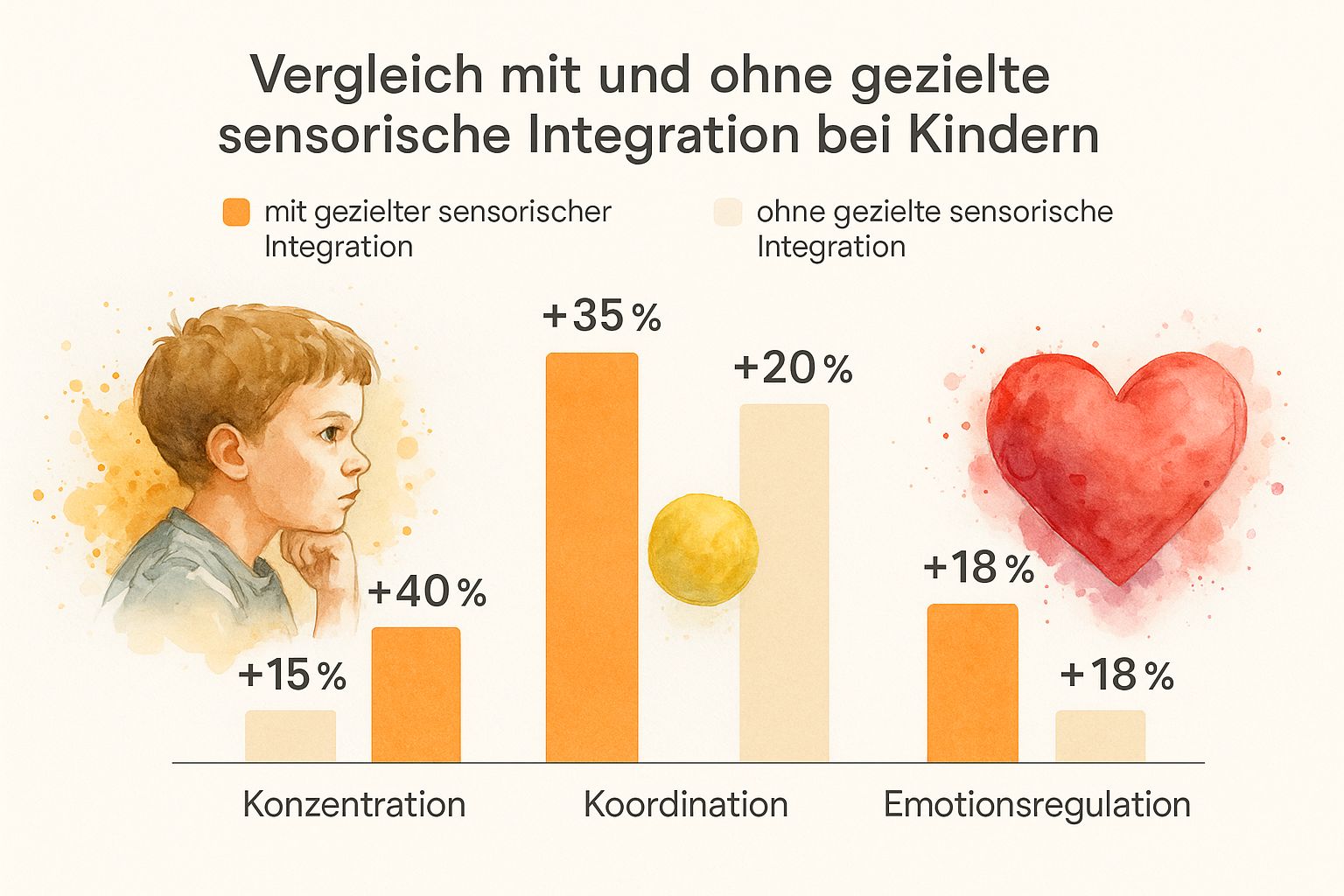
The data in this graphic makes it clear: Targeted sensory stimulation can truly make a difference compared to no specific support, leading to significant improvements in concentration, coordination, and emotional regulation. If we recognize the signs early, we can therefore provide targeted support to our children, helping them reach their full potential and navigate their daily lives with greater confidence.
Targeted development of the three fundamental senses

When we think about our senses, we usually think of sight, hearing, smell, taste, and touch. Sure, those are the classics. But there are three more, virtually invisible "basic senses" that lay the true foundation for our children's entire development. Their targeted stimulation is the core of sensory integration in children .
As a mother, I now see these three senses as my children's internal GPS. It's the system that helps them navigate their world safely and skillfully. Let's take a closer look at these superpowers and find out how we can easily strengthen them in everyday life.
The vestibular system: The internal compass
Imagine the vestibular system, located deep in the inner ear, as a state-of-the-art orientation sensor in a smartphone. It constantly reports to the brain which way is up and down, whether we are moving or standing still, and in which direction we are going. This sense is the absolute foundation for our balance, coordination, and spatial orientation.
A well-trained vestibular system gives children from the age of three the confidence they need for climbing, running, and balancing. So when my son happily whizzes through the air on a swing, it's much more than just play. It's an intense workout for this internal compass. Every swing, turn, and jump recalibrates this system and reinforces his sense of his own body in space.
The proprioceptive system: The body's map
Proprioception is like a built-in map of our body. Tiny sensors are located throughout our muscles, joints, and tendons, constantly reporting to the brain where our arms and legs are and how much force we are exerting. It is precisely this sense that allows us to find stairs in the dark or to grasp a cup without crushing it.
This sense is essential, especially for children aged 3 and older, to control their movements and regulate their strength correctly. Activities that put significant pressure and tension on the joints are invaluable in this regard.
- Practical example: My son helps me carry the (light) shopping bags from the car into the house. This "heavy work" gives him a great sense of his body and visibly grounds him.
- Action tip: Build a den together out of heavy blankets and pillows. Pushing and pulling the cushions is a fantastic proprioceptive exercise.
- Everyday trick: A firm hug where the child feels how much pressure is comfortable.
This "hard work" helps children feel grounded and centered again. It is often exactly what's needed to gently calm a restless or hyperactive child and help them regulate themselves.
Unfortunately, the sensory world of our children has changed drastically in recent years. National studies show that children are spending less and less time playing freely outdoors. In Germany, the average is now just under 40 minutes per day in the fresh air. This severely limits the natural stimulation of the vestibular and proprioceptive systems. In our article about these developments and their underlying causes, you can learn more about why free play is so indispensable.
The tactile system: The bridge to the world
The sense of touch, our tactile system, is so much more than just the ability to distinguish between rough and smooth. Through our skin, we perceive the world around us, we sense our own boundaries, and we build emotional bonds. For children, feeling and touching is a fundamental way to literally grasp their environment.
Playing in the sandbox, kneading dough, or painting with finger paints are not just creative games. They are essential learning processes in which the brain learns to process and categorize a wide variety of textures. A very simple example from our everyday life: When we bake together, my daughter gets to knead the dough. It's a sticky business at first, but a wonderful experience for her sense of touch.
By intentionally and playfully integrating these three basic senses into everyday life, we lay an invaluable foundation. We foster self-confidence, coordination, and a stable emotional base – at home, in daycare, and in therapy.
Practical play ideas for sensory integration at home

Now for the practical part! Having understood the theory behind the three basic senses, I, as a mother and founder, would like to share my personal favorite games for playing at home. The best part? You usually don't need any special equipment, just things you already have around the house.
These games are so much more than just a fun way to pass the time. They provide targeted "food" for your child's brain and are a wonderful way to easily integrate sensory development into everyday family life. All the ideas are perfect for children aged 3 and up and can be easily adapted to your child's preferences and pace.
Games for the sense of touch (tactile system)
Our sense of touch is the direct bridge to the world. Through feeling and touching, children learn to literally understand their surroundings and to be aware of their own physical boundaries. The following games sharpen the sense of touch and are also a lot of fun.
The mysterious touch box:
Grab an old shoebox and cut a hole in it big enough for a child's hand. Then fill the box with all sorts of everyday objects.
- Practical example: We use a mixture of natural materials (pine cones, smooth pebbles) and things from the kitchen (a soft sponge, a wooden spoon).
- How to play: My child reaches in without looking and describes what they feel: "It's hard and prickly!" Then they get to guess.
Painting with all senses:
Put the paintbrushes aside for a moment! Give your child finger paints, shaving cream, or even chocolate pudding on a washable tray. Smearing, smearing, and exploring with their hands is a true feast for the sense of touch. It helps children to experience and accept different textures without any pressure.
Games for body awareness (proprioceptive system)
Proprioceptive stimuli are like an internal GPS. They constantly give the brain feedback about where the body is in space and how much force it is currently exerting. Games involving pushing and pulling help children feel grounded and "at home" in their bodies.
The funny wheelbarrow:
This classic game is a real powerhouse for body awareness. You hold your child's legs firmly in the air while they run forward on their hands. This not only strengthens arms, shoulders, and core, but also sends intense signals to the joints and muscles. A short race down the hallway is often all it takes!
The Animal ABC:
Encourage your child to move like different animals. Let their imagination run wild!
- Jump like a frog: Deep squat jumps really challenge the large muscle groups in the legs.
- Crawl like a snake: Scuttling across the floor on your stomach is a great workout for your core muscles.
- Stomp like an elephant: Strong stomping provides great, noticeable feedback to the joints in the feet and legs.
Such games, which require "hard work," are often a small miracle cure for inner restlessness. When my children are completely overexcited again, a little test of strength or a wild pillow fight often does more than a thousand words to calm them down.
Games for the sense of balance (vestibular system)
Our sense of balance is our internal compass. Any kind of rocking, spinning, and balancing trains this important system. It gives children the motor skills they need for almost all everyday activities.
The pillow obstacle course:
Create an adventure landscape in your living room! Scatter various cushions, blankets, and pillows across the floor. The challenge is to get from one "island" to the next without touching the "lava floor." Balancing on the soft, wobbly surfaces is a fantastic and playful challenge for your sense of balance.
The roundabout party:
Turn on some cheerful music and dance around the room with your child. Incorporate turns in both directions. This intensely stimulates the vestibular system. Be careful not to overdo it, though, and stop before your child gets dizzy. A firm hug afterward will help to ground and calm the system.
If you're specifically looking for materials that stimulate different senses, a well-designed set can be a wonderful addition. Our sensory box was developed precisely for this purpose: to provide children with diverse tactile and proprioceptive experiences and to stimulate their creativity.
By incorporating such simple games into your daily routine, you actively promote sensory integration in children . You not only give your child valuable developmental time, but also create unforgettable shared moments full of laughter and joy.
How daycare centers and medical practices support sensory development
As the founder of Flowfull and a mother of two, I regularly speak with many educators and therapists. I know firsthand that in your daily work, you lay the foundation for the development of countless children. Professional institutions like kindergartens or occupational therapy practices, in particular, have a unique opportunity to create an environment that specifically and sustainably promotes sensory integration in children from the age of three.
You are often the first to notice when a child needs extra support in processing sensory stimuli. Simply by creating stimulating but not overwhelming spaces and integrating targeted activities, you can help all children feel more comfortable in their own skin and reach their full potential.
Create an environment that nourishes the senses
An educationally valuable space is so much more than just pretty decoration. It becomes an active partner in children's development. Even small adjustments to group rooms or the creation of a special sensory or movement room can have an enormous impact.
Just think of the three basic senses: balance, body awareness, and touch. A well-equipped room provides targeted stimuli for each of these areas.
- For balance (vestibular): A simple swing, a cozy hammock in a quiet corner or even large exercise balls – they all invite swinging and rocking movements that calibrate the vestibular system.
- For body awareness (proprioception): Heavy blankets, crawling tunnels, or a mat corner for roughhousing give children the opportunity to intensely experience their bodies. A practical example: Set up a "refueling station" where children can briefly "recharge" under a heavy blanket.
- For the sense of touch (tactile): A tactile wall with different materials such as sandpaper, felt and cork, or a box filled with sand or lentils, directly appeals to the sense of touch and invites exploration.
A well-designed space gives children the freedom to seek out precisely the sensory stimuli they need for their development at that moment. It's an invitation, not an obligation – and that's what makes all the difference.
Use proven methods from occupational therapy
Occupational therapy has long been a pioneer in promoting sensory integration. Many of its proven materials and methods can be wonderfully integrated into everyday kindergarten life to support all children – not just those with diagnosed needs.
Sensory integration therapy has proven to be an established and effective method in Germany. It is used in approximately 30–40% of occupational therapy practices for children with a wide range of developmental challenges. Studies show that approximately 60–70% of treated children experience significant improvements in their everyday skills.
A skateboard, for example, is not just a fun toy. It's also a fantastic therapeutic tool for strengthening core muscles and improving balance. Therapy swings offer a variety of movement options, from gentle rocking to rapid spins. Providing these tools specifically during free play enriches the everyday lives of all children.
Strengthening the team through knowledge and further training
The most valuable tool in any institution is and remains a competent and attentive team. Continuing education courses on sensory integration are an important investment, as they sharpen the awareness of educators.
If your team recognizes the signs of processing difficulties early on, it can respond in a targeted and sensitive manner. It learns not to label a child's behavior as "difficult," but to understand it as an expression of their sensory needs. This allows for the development of individualized support plans that positively shape daily life for the child and the entire group.
Collaboration between daycare centers and therapeutic practices is invaluable. Regular communication ensures that support measures at home, in daycare, and in therapy work seamlessly together, providing optimal support for the child. At Flowfull, we specialize in equipping daycare centers and therapeutic facilities with thoughtfully designed and durable play materials that support precisely these goals and enrich everyday educational practice.
When professional help through occupational therapy is beneficial
As a mother, I know this nagging uncertainty all too well: Is what my child is doing just a phase? Or is there perhaps more to it? Deciding to seek professional help is difficult for many of us. But from my own experience, I can only advise you: Trust your gut feeling. That's always the best first step.
Perhaps you've recognized your child in some of the described behaviors – be it extreme sensitivity to touch or that almost irrepressible urge to constantly move. If you notice that these characteristics are putting a strain on family life, that your child feels uncomfortable at kindergarten, or simply can't seem to join in playing with others, then it's absolutely right to take a closer look.
Signs that indicate a need
The point here is not to immediately label every behavior a problem. Rather, we should learn to recognize patterns. Certain indicators, especially in children aged 3 and older, can be a good reason to consult a pediatrician and consider an occupational therapy assessment.
- Significant delays in motor skills: Do you notice that your child seems very clumsy compared to peers, avoids the climbing frame, or has enormous difficulty getting dressed?
- Strong emotional outbursts: Do everyday situations like grocery shopping or brushing teeth regularly lead to violent tantrums from which your child can barely escape? My daughter went through a phase where washing her hair was a huge challenge for the whole family.
- Behavioral issues: Does your child withdraw completely? Or is he or she very rough with other children, perhaps because he or she doesn't have a proper sense of their own strength?
- Severe concentration problems: Does your child have great difficulty staying focused on one thing, even for a short time – unless it is a very intense physical activity?
The first step is always to visit the pediatrician. It's best to prepare for the appointment by noting down specific examples from your daily life. Describe exactly what you observe and when the challenges are greatest. With this information, the doctor can issue a prescription for occupational therapy.
An occupational therapy assessment is not an exam, but an opportunity. It's about understanding your child's unique sensory profile. Only then can we provide them with the precise support they need to better cope with everyday life.
Occupational therapy always begins with a thorough assessment. The therapist observes your child during free play and gives them specific tasks. This gradually creates a clear picture of their strengths and challenges in sensory processing. Sensory integration therapy , which is always playful, begins based on this assessment. In a specially equipped room – often with swings, wheeled boards, and a variety of tactile materials – your child receives precisely the stimuli their nervous system needs. The goal is to help the brain better sort and process all the sensory input.
If you're still unsure whether your child could benefit from such targeted sensory experiences, why not try it out at home? Our trial pack is a wonderful way to playfully discover which stimuli your child enjoys and what makes them feel good. Acting early can truly make a crucial difference and help your child go through life with more confidence and happiness.
Practical questions and answers on sensory integration
As a mother and founder of Flowfull , I receive countless questions about sensory integration in children every day. I've compiled the most important and frequently asked questions here and will try to answer them practically based on my own experience.
Does an integration disorder simply resolve itself with age?
This question concerns so many parents, and the answer is a clear "yes and no." A child's nervous system from the age of three is constantly developing and changing, of course. Nevertheless, fundamental difficulties in processing stimuli rarely disappear on their own. Without the right support, children often develop avoidance strategies to circumvent their problems – but this costs them an incredible amount of energy in everyday life.
Early, targeted support can make all the difference. Whether through playful activities at home, specific programs in daycare, or professional therapy, it helps the brain build new and better neural connections. Your child won't simply outgrow the disorder, but rather, with the right support, will develop their abilities.
What is the difference between this and "normal" perception?
Every child is unique, with their own individual sensory profile. The crucial boundary lies where perception interferes with daily life. Does it pose a real obstacle when it comes to mastering everyday tasks, participating in social life at kindergarten, or learning with joy?
A practical example from our lives: If a child dislikes itchy sweaters, that's a normal preference. But if they throw a tantrum every morning because of the seam in their socks and refuse to go to kindergarten, then it becomes a serious everyday problem that requires support.
How long will my child need to attend sensory integration therapy?
The duration is as individual as your child – unfortunately, there's no one-size-fits-all answer. Therapy isn't a quick fix, but a collaborative journey tailored precisely to your child's needs.
What matters is not how long the therapy lasts, but that it helps your child feel more comfortable and competent in their own body.
Some children only need a few months of targeted support to experience a real developmental leap. Others, whose challenges are more complex, may require support over a longer period. A good therapist will always work with you to set new goals and discuss progress. It's important that the therapy provides practical, everyday strategies for the family, daycare, and, of course, the child themselves.
At Flowfull®, we believe that the right toys lay the foundation for healthy sensory development. Our products are designed precisely for this purpose: they provide children with the stimuli they need for their growth.
If you are specifically looking for materials that appeal to different senses, a well-designed set can be a wonderful addition.
Our Flowfull The ® Sensory Box was specifically designed to provide children with diverse tactile and proprioceptive experiences and to stimulate their creativity.

