


Motor skills games for children aged 3 and up: Our 7 best game ideas for home & kindergarten
As Julia, founder of Flowfull and a mother of two myself, I know how magical it is to watch little hands discover the world. Grasping, balancing, building – every movement is a huge developmental step. But how can we specifically and joyfully foster these important skills, especially in our little ones from the age of three? The answer often lies in the simplest yet most effective games. Targeted games for motor skills are far more than just a pleasant pastime. They train hand-eye coordination, strengthen muscles, and boost self-confidence when a wobbly tower suddenly stands upright or a string is successfully threaded through a small hole.
In this article, I present seven tried-and-tested, carefully selected motor skills games specifically designed for children aged three and up, playfully supporting their development. These ideas are not only a wonderful addition to everyday family life at home, but also proven effective in kindergartens and therapeutic settings. For each game, you'll learn how it works, which specific skills it promotes, and how you can adapt it to your child's needs with creative variations. Let's discover together how we can playfully empower our children for the future – with practical tips, actionable ideas, and plenty of heartfelt enthusiasm.
1. Climbing Maxe (Climbing Game)
The Climbing Max is a timeless wooden toy that many of us remember from our own childhood. It's a wonderful example of how simple games can promote motor skills in a fascinating way. In this game, a small figure, often a monkey or a jumping jack, is attached to two strings. By alternately pulling on the strings, the figure climbs upwards – a seemingly magical moment for children aged three and up.
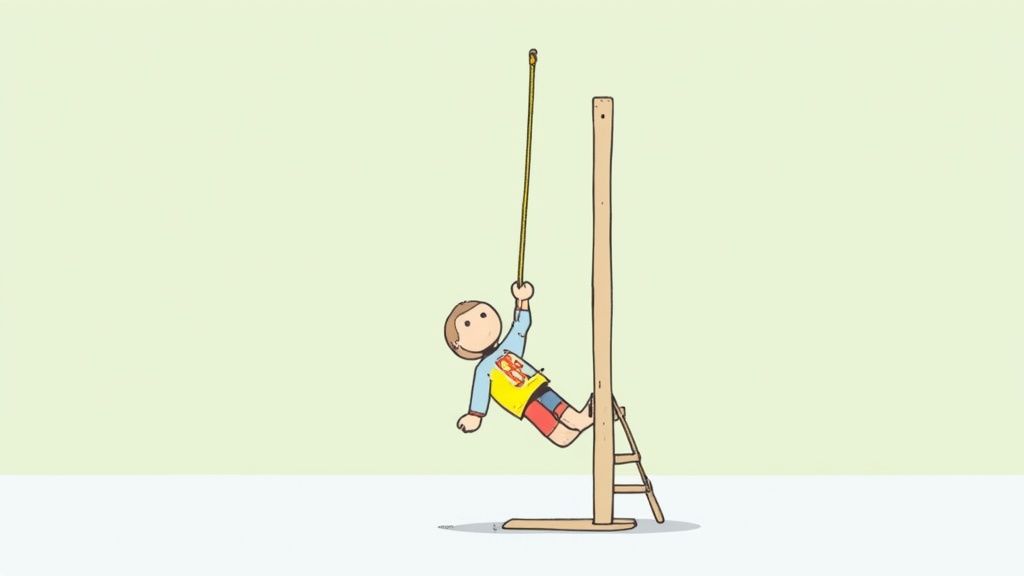
The educational value of this classic game is enormous. It specifically trains hand-eye coordination and bilateral coordination , that is, the cooperation of both hands. Children learn to precisely control their movements and find the rhythm that makes the figure climb. These very skills are crucial for later abilities such as learning to write or tying shoelaces.
This is how the climbing Max is used
In our family's daily life, the climbing frame has proven to be a fantastic tool for quiet moments. When my two children need to wind down after a hectic day at kindergarten, we often get it out. The focused, rhythmic movement has an almost meditative effect.
The game is also very popular in therapeutic and educational contexts:
- In occupational therapy: Therapists use the climbing frame to train finger strength, force modulation, and the coordination of both hemispheres of the brain.
- In kindergarten: Educators use it during free play or in targeted motor skills activities. Often, it turns into a small competition to see whose figure reaches the top first, which is particularly motivating for 4- to 5-year-olds.
Julia's tip: Combine the game with counting. Ask your child: "How many moves do you need until Max is at the very top?" This playfully supports early mathematical development.
Why the climbing enthusiast is convincing
The Climbing Max is more than just a toy. It's a simple yet highly effective tool for developing fine motor skills. The direct visual feedback – "If I pull here, the figure moves" – reinforces the understanding of cause and effect. The tactile experience of the wood and the simple mechanics make it a durable and lasting companion for your child's development.
2. Balancing board
The balance board, often also known as a wobble board, is an ingenious, open-ended piece of wooden play equipment. Its simple, curved shape immediately invites children from the age of 3 to explore it: as a seesaw, a bridge for toy cars, a slide, or simply as a tool for practicing balance. This versatility makes it one of the most valuable toys for motor skills , comprehensively supporting gross motor development.
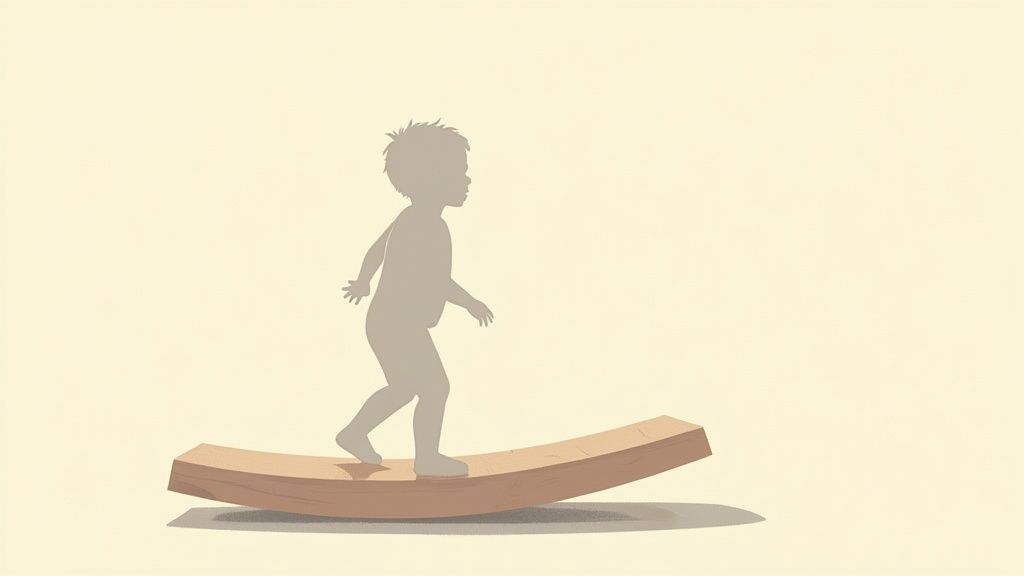
The educational value of the balance board lies in training the sense of balance and proprioception , that is, the perception of one's own body in space. When a child tries to stand on the board, their deep core muscles must constantly make minute balancing movements. This strengthens the torso, improves posture, and promotes coordination – important foundations for almost all sporting activities, but also for maintaining a steady sitting position at school.
This is how the balance board is used.
At our house, the balance board is a permanent fixture in the children's room and is reinvented daily. Sometimes it's a cave for stuffed animals, sometimes a racetrack for marbles. But when we want to specifically promote motor skills, we use it for little challenges, for example, seeing who can balance the longest while standing.
The board is also firmly established in professional environments:
- In pediatric physiotherapy: Therapists use it to train trunk stability, balance and reaction time after injuries or in cases of developmental delays.
- In Waldorf kindergartens: Here it is a central element of movement education, encouraging children to engage in free, creative and body-conscious play.
Julia's tip: Start on a soft surface like a carpet. Let your child practice barefoot to optimally utilize the sensory input from the soles of their feet. This provides better grip and improves perception. Those who are handy can find instructions online for building their own motor skills board .
Why the balance board is so convincing
The balance board is much more than just a toy for improving balance. It fosters creativity because it's not tied to any specific play purpose. Children learn their own physical limits by experimenting and gradually expanding them. The direct feedback – "If I lean too far, I'll tip over" – develops an understanding of physical laws like gravity and balance and is perfect for children aged 3 and up.
3. Mikado (Pick-up Sticks)
Mikado is a true classic that connects generations and ingeniously trains concentration and steady hands. Who isn't familiar with the bundle of colorful wooden sticks that is dropped, creating a delicate jumble? The goal is to pull one stick at a time from the pile without moving the others. These simple games for developing motor skills are true masters at teaching patience and precision.
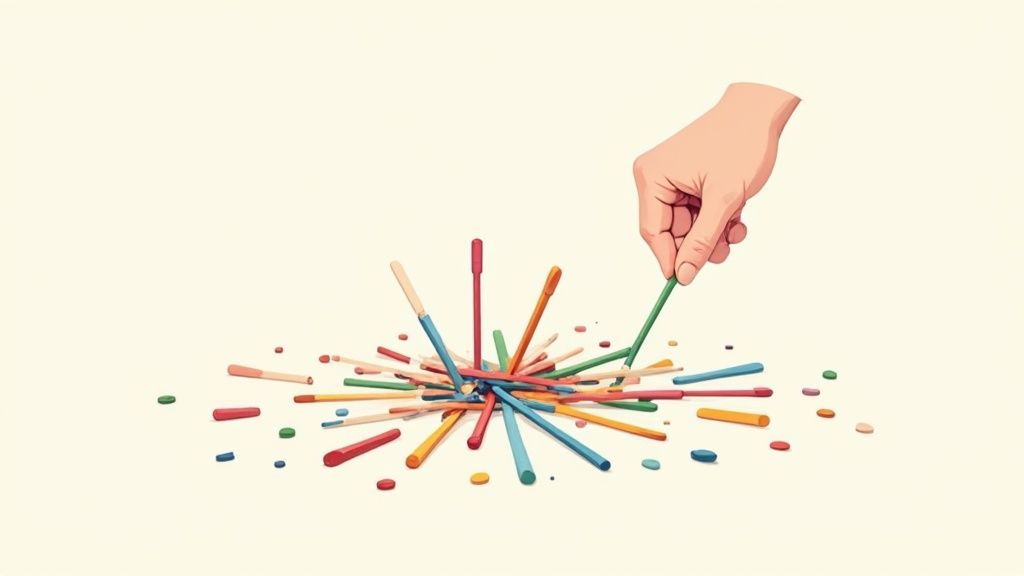
The educational value of Mikado lies in the targeted development of fine motor skills and visuomotor coordination . Children from around four years old learn to control their movements with extreme precision and to use their fingers effectively. They develop a steady hand and learn to translate visual information directly into motor actions. The precise pincer grasp , i.e., gripping with the thumb and forefinger, is intensively practiced here – a fundamental skill for holding a pencil.
This is how Mikado is used
At our house, Mikado is the perfect game to wind down after an exciting afternoon. The silence and the intense concentration the game requires act almost like a little mindfulness exercise for my children. They learn to focus on a single task and block out distractions.
The game is also indispensable in professional fields:
- In occupational therapy: Therapists use Mikado to promote hand stability, impulse control, and frustration tolerance. The game provides immediate feedback on the success of a movement.
- In preschool/kindergarten: Educators use it during rainy day breaks or as a targeted concentration exercise. It promotes strategic thinking, as the children have to consider which stick is easiest to remove.
Julia's tip: Simplify the start for younger children (from about 3.5 to 4 years old) by using only half the number of sticks. This creates larger gaps and guarantees early successes. Later, you can increase the difficulty and introduce a scoring system.
Why Mikado is convincing
Mikado is far more than just a game of skill. It's a valuable tool that teaches children to plan ahead and consider the consequences of their actions. The need to act calmly and thoughtfully fosters self-regulation in a playful way. It's a timeless game that requires no batteries or screens, yet remains captivating.
4. Lacing Games
Threading games are true classics when it comes to developing fine motor skills. Whether it's putting wooden beads on a string, threading yarn through punch cards, or creating colorful figures with pre-drilled holes – the principle is simple yet ingenious. These games for promoting motor skills require concentration, patience, and a steady hand, while children from the age of 3 learn to guide strings precisely through small openings.
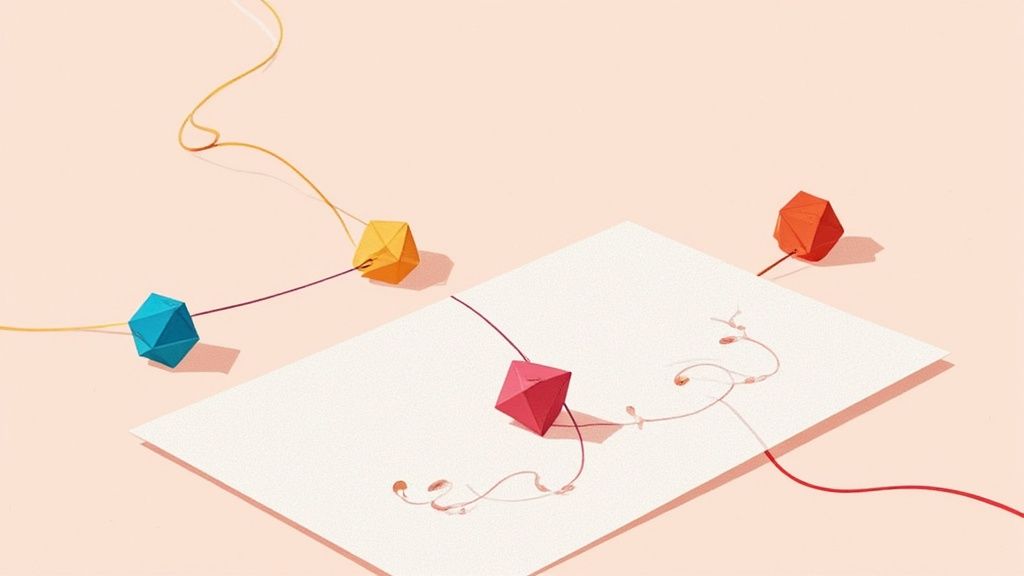
The educational value of threading games is exceptionally high and optimally prepares children for school. They specifically train the pincer grasp (the position of the thumb and forefinger), which is essential for holding a pencil. At the same time , hand-eye coordination is intensively trained, as the child must precisely align the movement of their hand with the targeted hole. Sequential thinking and pattern recognition are also playfully encouraged.
This is how threading games are used
At our home, threading games are the perfect companions for trips or quiet afternoons. They are compact, quiet, and hold my children's attention for a surprisingly long time. The handmade beaded necklaces are then proudly worn as jewelry or given as gifts to the grandparents.
They are also firmly established in professional environments:
- In kindergarten: As an integral part of the Montessori approach and in the free play area, they help children to concentrate and improve their fine motor skills.
- In occupational therapy: Therapists use threading games to train visual perception, motor planning, and bilateral coordination.
Julia's tip: Start with large beads and thick cords with reinforced ends. As your child gains confidence, you can introduce smaller beads and more complex beading cards. Create an extra challenge by specifying color sequences or patterns for them to recreate.
Why threading games are so appealing
Threading games are more than just an activity. They are a fundamental tool that helps children develop the motor skills they need for everyday tasks like getting dressed or, later, for writing. The process of threading not only strengthens the muscles in the hands and fingers but also boosts self-confidence – every successfully threaded piece is a small victory. These games are an excellent example of how sensory toys promote development by combining tactile and visual perception.
5. Spinning Tops
The spinning top is a fascinating toy that has delighted generations of children and is far more than just a colorful pastime. As one of the most classic games for developing motor skills, it impressively teaches basic physical principles while simultaneously training fine motor skills. Whether through a quick finger spin or pressing a plunger – setting a spinning top in motion requires dexterity and concentration.
The educational value of this simple game is considerable. It particularly promotes fine motor skills in the fingers and hand-eye coordination . Children from around three years old learn to find the right amount of force and the perfect impulse to make the top spin. This ability to precisely control and time movements is an important foundation for later skills such as holding a pencil, cutting with scissors, or buttoning a jacket.
This is how the gyratory is used
In our family life, spinning tops are a great way to pass the time or take a short, focused break from playing. We often have little competitions: whose top spins the longest? This motivates my children to continually refine their technique.
The gyroscope is also a popular tool in professional environments:
- In occupational therapy: Therapists use spinning tops to train the pincer grasp, finger strength control, and visual perception (tracking the rotating object).
- In kindergarten: Educators use various types of spinning tops during free play. Humming tops, which make noises when spinning, offer an additional auditory stimulus.
Julia's tip: Try different surfaces with your child. How long does the spinning top last on a wooden table, a carpet, or a tray? This turns the game into a small physics experiment and promotes logical thinking.
Why the roundabout is convincing
The spinning top is an excellent example of how games can train motor skills in a simple yet effective way. The immediate feedback – "If I do it this way, it falls over; if I do it differently, it spins for a long time" – helps children develop a deep understanding of cause and effect. The variety of shapes offers constant new challenges and ensures long-lasting fun for children aged 3 and up.
6. Hammer and Nail Game
The classic hammer game is an absolute favorite in kindergartens and at home, as it combines creativity with targeted strength training. In this game, children from about 3 to 4 years old use a child-sized wooden hammer to attach colorful wooden tiles to a corkboard with small nails. This creates the most imaginative pictures – a wonderful way in which games combine motor skills and creative thinking.
The educational value of this creative game is immense. It specifically promotes hand strength , hand-eye coordination , and proprioceptive feedback – that is, the perception of force and movement. Children learn to precisely control the force of their hammer blows and to hit the nails accurately. These skills are an important foundation for holding a pencil, using cutlery, or cutting safely with scissors.
This is how the hammer game is used
At our house, playing with a hammer is often a focused and productive afternoon activity. It allows my children to express themselves and proudly hold their own artwork in their hands at the end. The sounds of hammering often have a very calming effect.
Hammer play is also a proven method in professional contexts:
- In occupational therapy: Therapists use it to strengthen hand muscles, train bilateral coordination, and give children a way to release energy in a controlled manner.
- In kindergarten: In the workshop corner or during creative activities, children can work from template cards or let their imagination run wild and create their own pictures.
Julia's tip: Start with simple shapes and encourage your child to grip the hammer correctly. Ask, "What would you like to build? A house, a car, or an imaginary animal?" This promotes language development and the ability to plan ahead. Make sure your child is always supervised.
Why the Hammer game is convincing
Hammering is far more than just a nail game. It's a valuable tool that gives children a sense of competence and self-efficacy. The direct experience – "I can create something with my hands and tools" – greatly boosts self-confidence. At the same time, it trains concentration and visual perception as shapes and colors are combined to form a complete picture.
7. Pegboard Games
Pegboard toys are among the fundamental educational toys that should be in every child's room or kindergarten. They are a prime example of games that simultaneously stimulate motor skills and cognitive abilities. In these games, colored pegs or shapes are placed on a pegboard to create patterns or pictures. Models with larger pegs are particularly suitable for children aged 3 and up.
The educational value is immense, as stacking toys demand fine motor skills at the highest level. Grasping and precisely placing the small pieces trains the pincer grasp, an essential prerequisite for holding a pencil. At the same time , hand-eye coordination , spatial reasoning, and color recognition are fostered. Children learn to recreate templates or give free rein to their own creativity.
This is how peg games are used
In our family life, we often use stacking games for focused play sessions at the table. My older child especially loves creating complex patterns using template cards, which noticeably improves his perseverance and concentration. It's the perfect activity to wind down after an active afternoon outdoors.
Even in professional settings, pegboard games are an indispensable tool:
- In kindergarten: Educators use them to promote pattern recognition and as preparation for writing. Large, collaborative pegboard pictures are often created in group work.
- In occupational therapy: Therapists use peg games specifically to train hand strength, visual perception and bilateral coordination (use of both hands).
Julia's tip: Start with larger pegs and simple patterns for younger children. Later, you can challenge your child by asking them to create a mirrored pattern or to "paint" their own story with the pegs.
Why stacking games are so appealing
Peg games are much more than just a colorful puzzle. They are a versatile learning tool that combines creativity and logical thinking. The direct tactile experience – feeling and placing the pegs – creates a deep understanding of shapes, colors, and spatial relationships. The clear feedback – the peg fits or it doesn't – strengthens the understanding of precision and promotes frustration tolerance.
Motor skills games: A comparison of 7 classics for children aged 3 and up
| Game title | 🔄 Implementation complexity | 🛠️ Resource requirements | 📊 Expected results | 💡 Ideal use cases | ⭐ Main advantages |
|---|---|---|---|---|---|
| Climbing Max | Means: Mechanics with ropes | Low: wood, ropes | Fine motor skills, bilateral coordination, timing | Kindergarten, therapy, quiet play at home | Strengthens finger strength, patient coordination |
| balance board | Medium to high: Balance required | Medium: Wood, non-slip surface | Gross motor skills, balance, core strength | Movement spaces, physiotherapy, creative play | Versatile, promotes body control and sensory perception |
| mikado | Low difficulty: Simple gameplay | Low: Colorful wooden sticks | Fine motor skills, concentration, strategic thinking | Preschool, therapy, family afternoons | Improves focus and planning, quick to deploy |
| Threading games | Minor: Threading, Lacing | Low: cards, strings | Fine motor skills, pre-writing skills | Kindergarten, preschool, Montessori | Promotes pattern recognition and patience |
| roundabout | Low to medium: Learning to turn | Low: Wooden spindle | Fine motor skills, timing, visual tracking | Sensory games, short breaks in play | Direct sensory feedback, cause and effect |
| Hammer game | Means: Coordination with hammer | Materials: wooden mallet, nails, cork | Gross motor skills, hand strength, proprioceptive perception | Kindergarten workshop, occupational therapy | Strengthens wrist, promotes creativity |
| Stacking games | Low weight: Easy to plug in | Low to medium difficulty: Stacking games | Fine motor skills, spatial reasoning, color recognition | Early education, kindergarten, therapy | Supports visual and motor skills |
More than just playing: A strong start in life
As our journey through the world of motor skills games shows, fostering these fundamental abilities is far more than just a pleasant pastime for children aged 3 and up. From the delicate threading of a bead to focused balancing on a board to a well-aimed hammer blow – each of these activities is a crucial building block for healthy child development. The motor skills games presented here have been deliberately chosen not only to be challenging, but above all to bring joy and awaken a child's natural curiosity.
As a mother, I see every day how important these playful learning experiences are. It's those moments when a child finally gets a spinning top to dance after many attempts, or proudly presents a necklace they've strung themselves, that sustainably boost their self-confidence. These successes convey a powerful message: "I can do it!" This conviction is the foundation for future learning processes, whether in kindergarten or when facing everyday challenges.
Key findings at a glance
The games presented cover a broad spectrum that is crucial for holistic development:
- Gross motor skills: Games like the balance board train coordination, balance, and force modulation. These are the basis for safe movement patterns.
- Fine motor skills: Activities such as threading games, Mikado or the hammer game train hand-eye coordination, the pincer grip and the precise control of small muscle groups.
- Cognitive skills: Almost all games for motor skills also promote concentration, patience, problem-solving skills and an understanding of cause and effect.
The real magic, however, lies in the connection between these areas. When a child recreates a pattern in a pegboard game, they not only train their fine motor skills, but also their spatial reasoning and concentration.
Your next step: From knowledge to action
Your role as parents, educators, or therapists is to create the right environment. Start small and carefully observe which activities your child finds particularly engaging. Intentionally integrate one of the suggested games into your daily routine. Perhaps the balance board will become a daily five-minute challenge before dinner, or the threading game a regular part of quiet playtime in the afternoon.
The key is not to follow a rigid exercise program, but to create a stimulating environment where the child can freely develop and experiment. Vary the games, combine materials, and allow room for creativity. The best games for motor skills are those that children can continually rediscover. By providing our children with these tools, we not only give them motor confidence but also the invaluable ability to actively and confidently shape their world.
Are you looking for thoughtfully designed play materials that address these developmental principles? At Flowfull , we develop products that specifically promote motor skills, creativity, and free play. Discover our selection of educational games on Flowfull that will support children on their path to a strong start in life.

