


Sensory bathtub for children aged 3 and up: A practical guide from a mom for moms
Hi, I'm Julia, founder of Flowfull and mother of two incredibly curious children, ages four and six. Like many of you, I was looking for a meaningful alternative to screens – something that would truly captivate my children while also fostering their development. That's when I came across the sensory tub . What started as a small experiment with a bowl of rice and a few spoons has evolved into one of our favorite family rituals and an invaluable tool in our daily life.
My journey into the world of sensor-equipped bathtubs
I can still vividly remember the first time I prepared a sensory tub for my then three-year-old daughter. It was one of those typical, gray afternoons, everyone was in a bad mood, and I desperately needed something to do that was more than just the usual plastic toys. The result blew me away: her eyes lit up when she first dipped her hands into the cool, dry rice.
That moment was a real eye-opener for me. I watched as she became completely absorbed in her game – the pouring, the feeling of the grains, the concentrated sorting. It was so much more than just a distraction. It was a profound, sensory learning experience, right before my eyes.
A sensory tub is not just an ordinary toy to me. It's a gateway to the world. A safe space where children from around 3 years old can explore independently, become creative, and incidentally develop important life skills.
In this post, I'd like to share my personal experiences and best practical tips with you. I'll show you how a simple sensory tub can stimulate the senses, creativity, and fine motor skills of your children aged 3 and up in a wonderfully natural and playful way.
We'll explore why this simple concept is not only a real asset for families like mine, but also offers tremendous added value in daycare centers and therapeutic facilities. It's about much more than just keeping children occupied – it's about targeted development that's genuinely fun.
Why this approach is so effective
The magic lies in the simplicity and the direct, tangible experience. Unlike most digital games or ready-made playsets, there is no right or wrong here. The child is the director, the explorer, and the creator of their own little world. This kind of free, self-directed play is invaluable for development.
- Practical example of problem-solving: My son (4) wanted to build a bridge out of kinetic sand over a "river" made of blue glass bricks. The bridge kept breaking. After several attempts, he discovered that he needed to compress the sand mold more firmly. That's applied physics!
- Boosting self-confidence: Every successful experiment, such as balancing stones on a "raft" made of bark, strengthens confidence in one's own abilities.
- Promoting language development: The game naturally encourages speaking. I often ask, "How does that feel?" Then I get answers like "smooth," "cold," or "ticky." Suddenly, little stories are invented, which expands vocabulary in a playful way.
What makes a sensory bathtub so special
Imagine a small, manageable world that your child can explore, change, and literally grasp to their heart's content. That's exactly what a sensory tub is. Essentially, it's a clearly defined play area—often a shallow box or tub—filled with carefully selected materials that invite touching, pouring, sorting, and experimenting.

For children aged three and up, this is far more than just "playing with mud". It's more like a small laboratory where they playfully become researchers. Every grasping, pouring, or mixing action is a real experiment that suddenly makes fundamental physical laws concrete and understandable.
More than just a toy
When children handle sand, water, lentils, or natural materials, they gain tangible experiences that lay the foundation for logical thinking. They learn about relationships like cause and effect quite intuitively – for example, when they observe how water deforms sand or how heavy stones sink while light leaves float.
This type of play has been proven to strengthen neural connections in the brain. It promotes concentration, language comprehension, and hand-eye coordination in a way that hardly any other toy can. I experienced this with my own son: only through the focused sorting of colorful pom-poms with tweezers in the bathtub did he begin to reliably name colors.
A sensory tub is a safe space that allows children to explore their environment without being overwhelmed. They can regulate the level of stimulation themselves, which is an invaluable advantage, especially for more sensitive children.
The concept is already well-established in the education sector. Specialized teaching aids, such as the sensory tray for light cubes produced in Germany, demonstrate the value of such multisensory experiences. These systems – often battery-powered and featuring vibration effects – are specifically used in early childhood and inclusive education to train tactile perception. You can learn more about these teaching aids on the Wiemann Lehrmittel website .
The most important benefits for children aged 3 and over
Targeted development through a sensory bathtub impacts several key areas that are crucial, especially for children of kindergarten age:
- Fine motor development: Handling small objects, using tweezers or spoons specifically trains the muscles in the fingers and hands – a perfect preparation for holding a pen.
- Cognitive skills: Sorting and counting tasks, such as sorting pasta by shape into different bowls, playfully lay the foundation for mathematical understanding.
- Language development: By describing the materials ("This is soft", "cold" or "rough") and inventing stories about the play world, vocabulary is actively expanded.
- Emotional regulation: Concentrated, repetitive hand play has a strong calming and grounding effect. After an exciting day at kindergarten, fifteen minutes of quietly pouring rice often helps my son to calm down again.
Creative play ideas for the whole year
The truly ingenious thing about a sensory tub is its almost endless versatility. From my experience as a mother, I know that the best play ideas are often the simplest and can be wonderfully linked to the seasons. Here are a few of our absolute favorites, which have proven their worth time and again at home and in our daycare setting. Each theme offers new learning opportunities and, as a bonus, promotes fine motor skills.
Seasonal themes for endless fun
- Spring – The Mini Garden: Fill the tub with soil (or coffee grounds as a cleaner alternative), small shovels, watering cans, and dry beans or flower seeds. My children love planting the "seeds" and later "watering" them with a spray bottle. It's a wonderful, grounding experience.
- Summer – The Cool Ocean: Color water with a few drops of blue food coloring and add seashells, small sea creatures, and ice cubes. Children can use measuring cups to find out which objects float and which sink – a first, playful lesson in physics.
- Autumn – The Forest's Treasure Trove: Fill the tub with chestnuts, acorns, colorful leaves, and dry corn kernels. Using tongs and small bowls, these become fantastic counting and sorting games. This also improves concentration, especially when trying to grasp a smooth chestnut with tweezers.
- Winter – The glittering ice landscape: A mixture of cornstarch and conditioner creates fantastic, cooling artificial snow. Add ice cubes, cotton balls as snowballs, and small penguin figurines to create a fascinating play world.
You can also find many more suggestions on how to make your own sensory toys in our magazine.
Tools and what they do
The real developmental leap only happens when the right tools come into play. It's not just about what 's in the bathtub, but also about what the children do with it .
- Tweezers and pliers: These are invaluable for practicing the pincer grip – the foundation for later holding a pen. Action tip: Let your children "rescue" small pom-poms and sort them by color into an egg carton.
- Shovels & spoons: They promote gross motor coordination of the hand and the first understanding of quantity relationships such as "a lot" and "little".
- Measuring cups and funnels: These playfully teach concepts like volume. Precisely pouring rice or water trains hand-eye coordination.
My practical tip: Let your child choose their own tools. This freedom greatly fosters creativity and independence. You'll be amazed at the imaginative ideas your child comes up with when they transform a funnel into a megaphone or a shovel into an excavator.
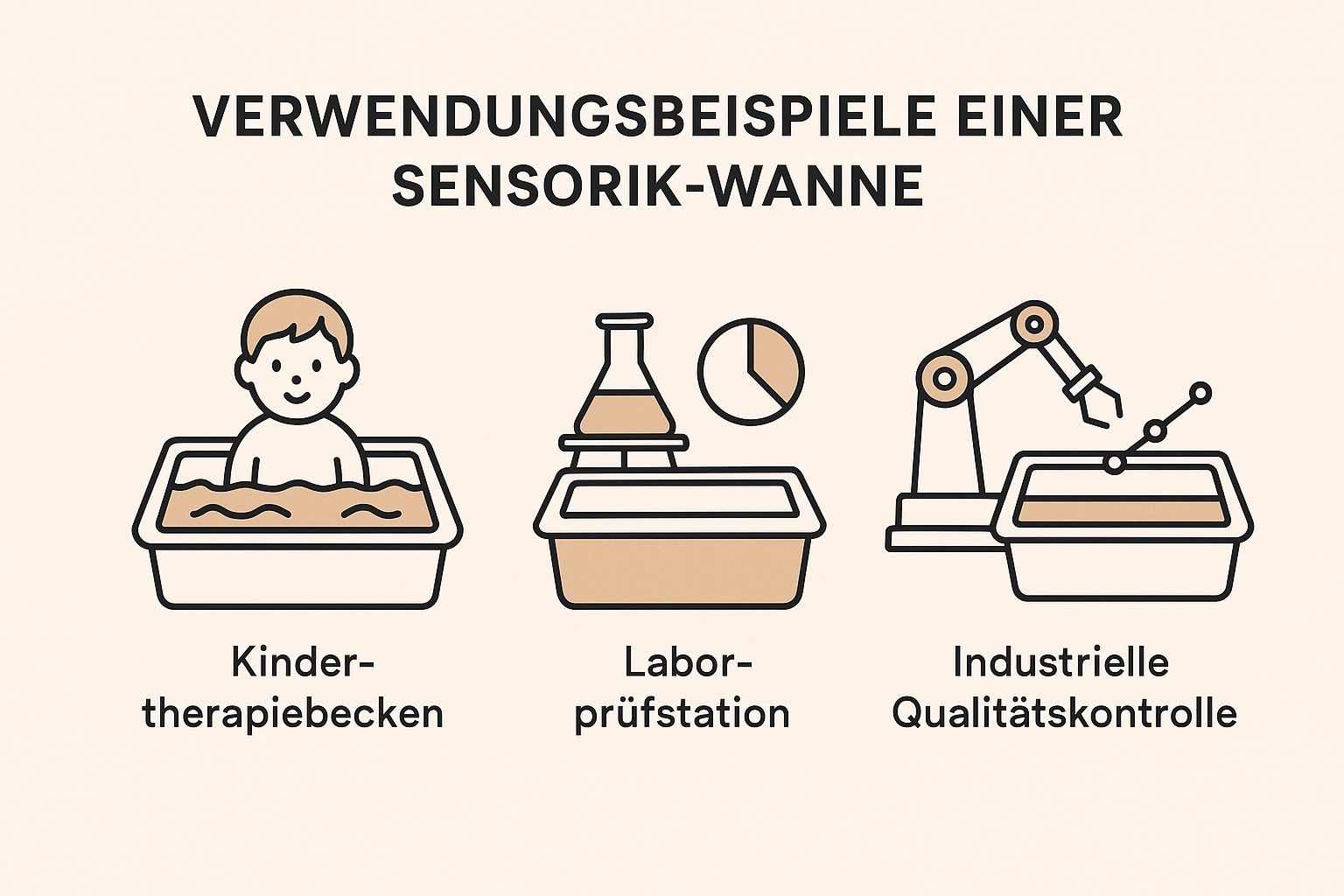
The sensory bathtub in daycare and therapy – More than just a toy box
In conversations with educators and therapists, it becomes increasingly clear to me what a powerful tool the sensory tub can be. While at home it is often a place for free, intuitive exploration, in professional hands it transforms into a precise instrument for kindergartens and therapy practices.
In daycare, for example, the bathtub is a fantastic place for inclusive play. I have often observed how children with completely different needs and developmental stages come together at the bathtub and learn from each other.
A four-year-old child with motor difficulties might simply pour sand, while another child nearby is already creating imaginative patterns with stones. Both are acting at their own level, at their own pace, but together. Along the way, social skills such as consideration, cooperation, and sharing are practiced.

Targeted support in occupational therapy
The sensory tub truly shines in therapeutic settings. In occupational therapy, it is used to achieve very specific goals. A child with tactile aversion, who finds many touches unpleasant, can gradually explore different textures like dry rice or soft sand – at their own pace.
The sensory tub provides a safe yet motivating environment. The playful setting lowers inhibitions and transforms necessary repetitions into an adventure for children, rather than a strenuous exercise.
Action tip for therapists: Hide small, magnetic letters in kinetic sand. The child should find them with a "magnetic magic wand" and name them. This trains concentration, pincer grasp, and letter recognition simultaneously, without feeling like work. You can find more insights like this in our article about why educators and therapists recommend Flowfull .
Sensory bathtubs and modern therapy approaches
The potential applications are evolving even further. Particularly in physiotherapy, sensory aids can support movement sequences or provide targeted tactile feedback. Research shows that wireless sensor networks, which in a broader sense can also include vibrating or otherwise stimulated bathtubs, have great potential for therapeutic purposes.
These professional applications make it clear: A sensory tub is so much more than a box of sand. It is a flexible, adaptable, and highly effective tool that can promote the development of children from the age of 3 onwards at all levels.
The right equipment for safe and fun play
Sensory play should be, above all, a joy for your child. To keep it that way and prevent it from turning into a cleaning nightmare, you don't need much. But as a mom, I know that a little thought beforehand about the right equipment and safety can make a huge difference.
The centerpiece is, of course, the sensory bathtub itself. Make sure your child can comfortably play with it while standing. For children three years and older, it's best if the edge of the tub is approximately at hip height.
The most important thing: the material of the bathtub
When it comes to the bathtub itself, there are a few clear criteria that make everyday life much easier:
- BPA-free plastic: My absolute top recommendation. This material is lightweight, robust, and food-safe. So you don't have to worry if lentils or pasta happen to end up in the tub.
- Easy cleaning: A smooth surface without grooves or nooks and crannies is a blessing. One wipe, and you're done!
- A practical lid: Never underestimate the power of a good lid! It protects the contents from dust and curious pets. Plus, you can easily leave a partially completed game world set up for the next day.
My most important tip for home, which I highly recommend to every mom: Always put a large, washable floor mat under the bathtub. This reduces the cleaning effort after an enthusiastic play session by what feels like 90% and saves your sanity.
Play safely: A look at packing material and accessories
Just as important as the tub itself is what goes in it. Here, a simple rule applies: your child's safety comes first. Always ensure that all filling materials and toys are non-toxic and large enough so that nothing can be swallowed. This is especially crucial for children around three years old, who still like to explore the world with their mouths. Small parts like beads are only a good idea if you are sitting right next to them.
Professional tips for daycare centers and medical practices
In professional settings, such as daycare centers or therapy practices, different rules often apply. A sensory tub on sturdy wheels is invaluable here, as it can be easily moved from one room to another. If water play is frequent, an integrated drain tap is a huge help. It's these small details that save valuable time and energy in everyday educational practice.
Frequently asked questions about the sensory tub
In closing, as founder and mother of two, I'd like to answer a few questions that I frequently encounter in conversations with parents and educators. These are the typical little uncertainties that might make someone hesitate at the beginning.
At what age is a sensory bathtub useful?
While you can offer babies very simple sensory experiences, the sensory tub really unfolds its full potential from around the age of three . This is the magical time when children make a huge developmental leap.
Their fine motor skills are then advanced enough to handle spoons and tweezers. At the same time, their imagination blossoms and they begin to invent real little role-playing games. That's precisely why our ideas are tailored to this age group, because the interplay of touch, creativity, and early logical thinking is simply most exciting at this stage.
Which materials are best suited for beginners?
My tip: Just get started! Ideally with materials that are uncomplicated, safe, and clean.
- Dry classics: Uncooked rice, large lentils, or chickpeas are perfect. They feel great, pour beautifully, and are quickly absorbed.
- Kinetic sand: An absolute favorite with my children. It can be shaped like damp sand, but hardly crumbles and never dries out.
- Water with accessories: The best way to get started with "wet play" is outdoors or in the bathroom. Add some foam letters or small boats.
The most important thing is and remains safety: Make sure there is no risk of suffocation and that the materials are non-toxic, especially for children who still like to put things in their mouths.
How do I keep everything clean?
I hear this concern all the time – but believe me, it's simpler than it looks. The tub itself can be wiped clean in no time with water and a little soap. Dry fillings like rice are simply poured through a coarse sieve after playtime and stored in an airtight container. This way, they're ready to use countless times. Materials like shaving foam or slime are, of course, intended for single use only.
Do I need to buy a special sensor-equipped bathtub?
No, absolutely not! Especially to start with, a large, flat storage box from the hardware store is often perfectly sufficient. An old baby bathtub will do, too. The main thing is that the edges aren't sharp and your child can easily reach them. Professional models, like the ones you find in daycare centers, certainly have their advantages, but for home use, a simple solution is just as valuable. After all, the magic doesn't come from the tub, but from your child's imagination.
At Flowfull, we firmly believe in the power of free, creative play. Our products are designed to give children the space they need for their development. Discover our world of sensory play now at https://flowfull.de and give your child unforgettable learning moments.

