


Sensory Table Ideas: Creative Play Worlds for Children Ages 3 and Up
Hello, I'm Julia, founder of Flowfull and a mom of two wonderful little explorers. I see every day how important it is for children to experience the world with all their senses. A sensory table is so much more than just a toy – it's a gateway to a world full of creativity, learning, and joy. Especially for our little ones from age 3 and up, who explore their surroundings with boundless curiosity, such a table offers the perfect, safe environment for imaginative play.
In my work with families, as well as with kindergartens and therapists, I've learned how versatile and effective these tables can be. They not only promote fine motor skills and concentration, but also help children to calm down and process sensory impressions in a focused way. Many parents and educators are looking for inspiring sensory table ideas that are easy to implement and offer real added value.
That's precisely the goal of this article: to provide you with a collection of practical and creative ideas that can be implemented immediately. We'll explore various themes and materials, from classic water and sand worlds to captivating light and nature tables. Let's dive in together and discover how you can create unforgettable play worlds with simple means, worlds that will empower and inspire your children aged 3 and up.
1. The classic: Water and sand play station
Few ideas for a sensory table are as timeless and proven as the combination of water and sand. I still vividly remember how my own children spent hours building muddy castles or watching sand dissolve in water. This basic play station, often equipped with two separate containers, is the perfect introduction to the world of sensory learning for children aged three and up.
The fascination lies in the contrasts: the cool, flowing nature of the water meets the warm, grainy texture of the sand. Children can experience fundamental physical principles firsthand here. What happens when you put dry sand into water? Which objects float and which sink? These simple experiments not only promote tactile awareness but also lay the foundation for scientific thinking.
Practical implementation and tips
Setting it up is incredibly easy. Models like the IKEA FLISAT table with TROFAST boxes or special water and sand tables from manufacturers like Step2 are ideal, as they are robust and easy to clean.
Here are a few tips from my experience to enhance the gaming experience:
- Minimize the mess: Instead of regular play sand, I like to use kinetic sand indoors. It sticks to itself and is much easier to clean up. Of course, any kind of sand is welcome outdoors!
- Encourage mathematical understanding: Give your children aged 4 and up measuring cups, funnels, and spoons in different sizes. This way, they playfully learn concepts like volume and proportions. For example, create a "soup kitchen" where they mix sand and water to make different "dishes."
- Keep things interesting: Change the accessories weekly. Shells, small toys (e.g., sea creatures), or even ice cubes in the water keep the game exciting and constantly stimulate the imagination.
The following infographic summarizes the key features, advantages and maintenance requirements of this classic sensory table idea.
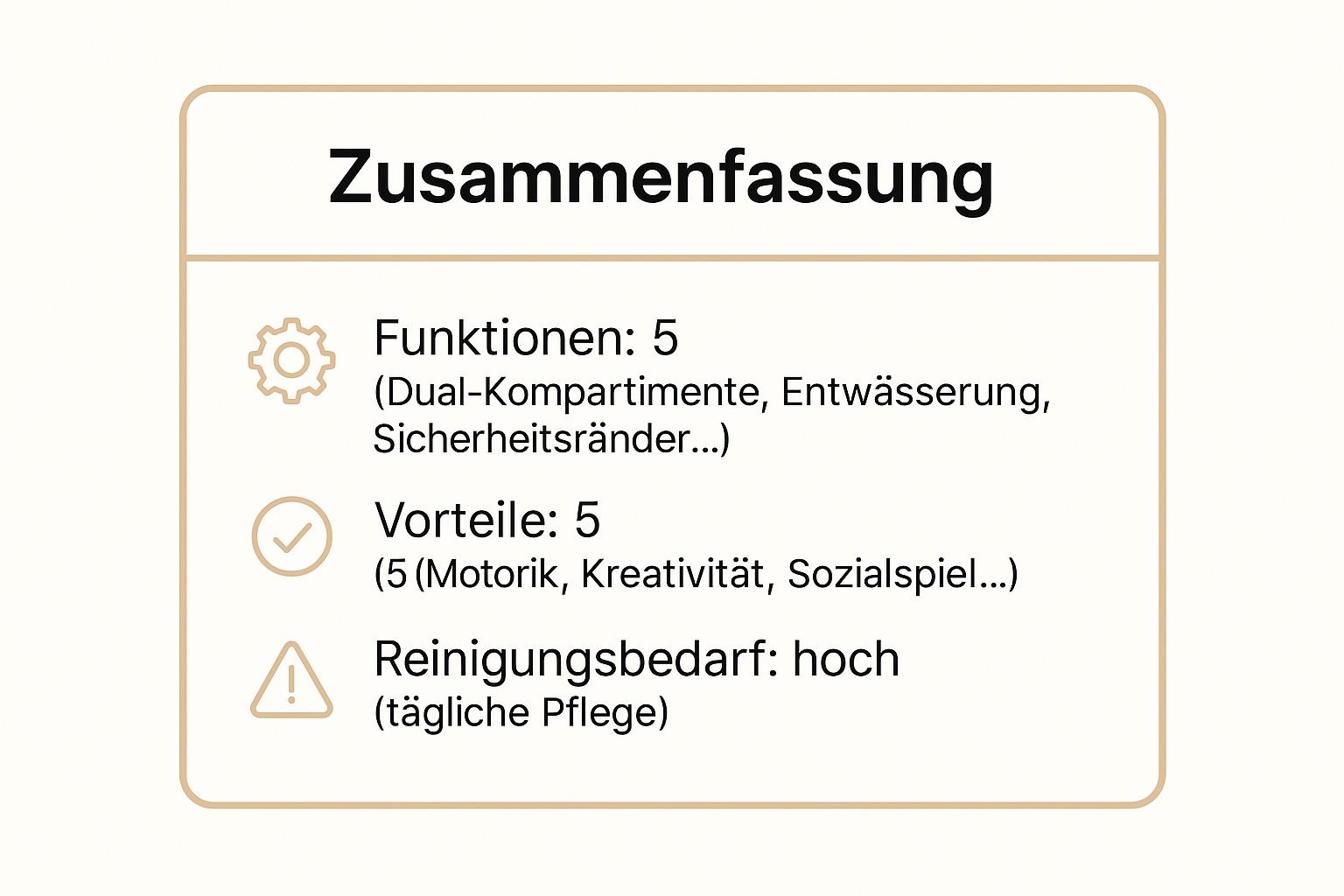
As the overview shows, the educational benefits far outweigh the slightly higher cleaning effort. The promotion of motor skills, creativity, and even social skills when several children play together in kindergarten makes this classic activity an invaluable resource.
Visual inspiration
To show you how versatile and engaging a simple water and sand table can be, watch this video. It's full of creative play ideas that you can implement immediately at home or in your facility.
2. The Light Table: Magic with translucent materials
One of my absolute favorite ideas for a sensory table is to transform it into a light table. This variation, heavily inspired by the Reggio Emilia approach, uses an illuminated surface to bring translucent materials to life. I've often watched my children become completely absorbed in the interplay of colors, light, and shadows. For children aged three and up, this opens up a fascinating world that extends far beyond the tangible and trains visual perception in a unique way.
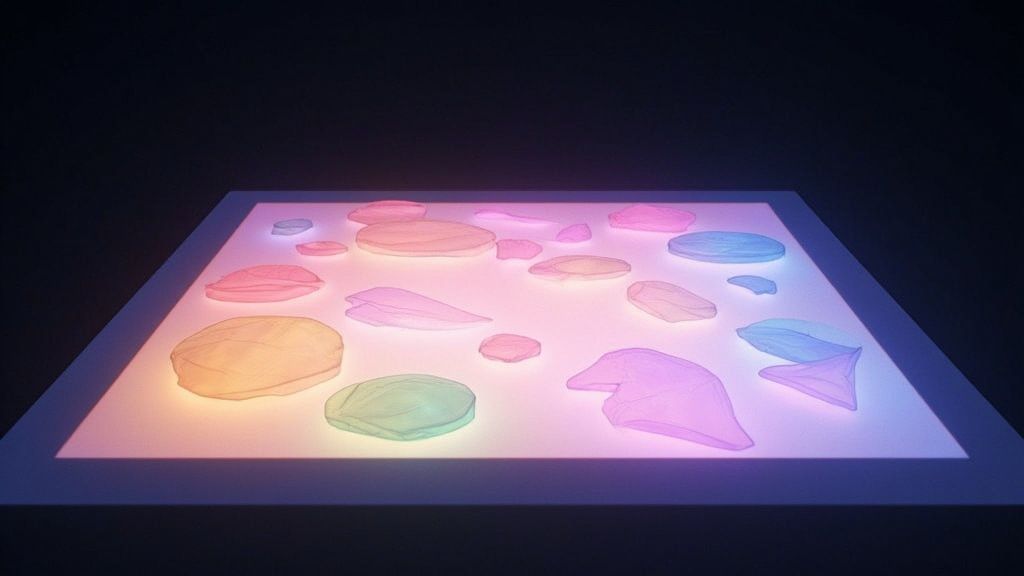
The special appeal lies in the visual stimulation. When light shines through colored objects, new colors and shapes emerge. Children playfully learn about concepts such as transparency, opacity, and color mixing. What happens when you place a blue and a yellow sheet on top of each other? How does the shadow of a leaf change when you move it? Such discoveries are not only visually captivating but also promote critical thinking and concentration.
Practical implementation and tips
Setting up a light table doesn't have to be complicated. While there are dedicated light tables available for purchase, an LED string light or a flat LED panel placed under a transparent TROFAST box (e.g., from the IKEA FLISAT table) serves the same purpose and is a cost-effective alternative.
Here are a few tried-and-tested tips to maximize your light table experience:
- Experimenting with colors: Use transparent colored tiles or colored glass stones. Children can layer these and directly experience the basics of color mixing. A practical example: Ask your child to find all the blue and yellow stones and mix them to discover "green".
- Incorporate natural materials: Place pressed leaves, blossoms, or thin slices of fruit and vegetables on the table. Under the light, the fine structures and veins become visible, encouraging close observation.
- Focus on details: Give your child a magnifying glass. This will allow them to explore the fine details of objects even more closely. This fosters patience and the ability to observe carefully, which is important preparation for school.
- Create themed worlds: Decorate the table to match the season. In autumn, it could be colorful leaves, in winter ice crystals made of transparent material, and in spring, blossoms and grasses.
The light table is one of the most versatile sensory table ideas , as it can be easily adapted to different themes and learning objectives. It is ideal for quiet, focused play sessions and is often used in therapeutic contexts, such as for supporting children on the autism spectrum.
3. Explorer table with rice and beans
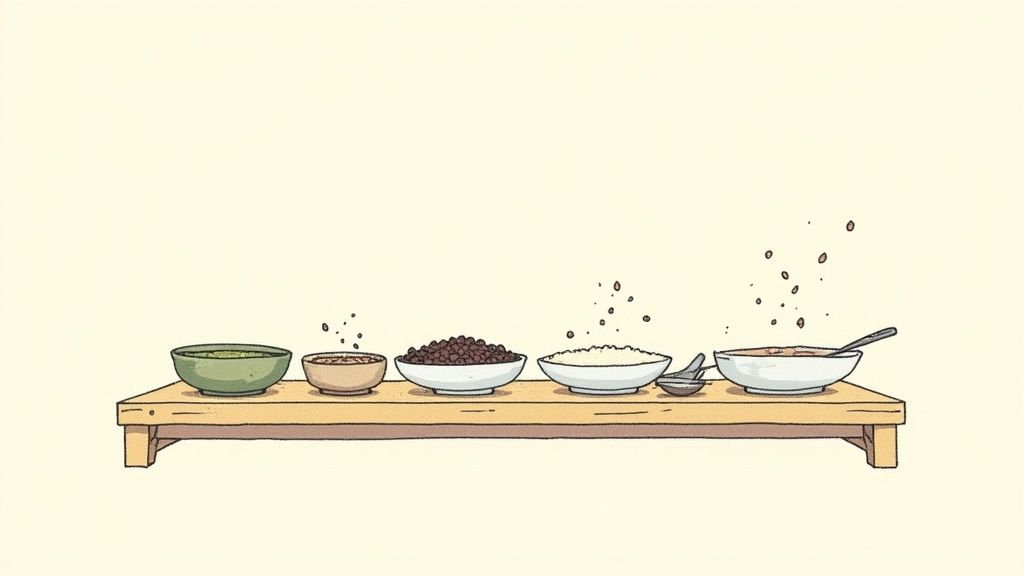
One of my favorite sensory table ideas, which is both inexpensive and incredibly versatile, involves a filling of various dried legumes, rice, and grains. It's fascinating to watch children as young as three immerse themselves in this world of different textures, sounds, and tactile experiences. The sounds made as the rice trickles through their fingers or the beans fall into a cup provide wonderful auditory stimulation.
This approach, often used in Waldorf education or occupational therapy, is perfectly suited for indoor use, as it remains relatively clean and offers a rich sensory experience. Pouring, sorting, and grasping the small items is excellent training for fine motor skills and hand-eye coordination.
Practical implementation and tips
Preparation is incredibly simple, and the materials are often already available in the kitchen. I always make sure to offer a mix of different sizes and shapes to maximize the tactile appeal.
Here are a few tried-and-tested tips to enhance the game:
- Create a variety of textures: Mix large kidney beans with small lentils or chickpeas. Each material feels different and makes a different sound. Sorting the beans beforehand is a great group activity for kindergartens.
- Provide the right tools: pliers, spoons, small shovels, and sorting containers specifically promote fine motor skills. Children love sorting the different grains by color or size.
- Create themed worlds: Hide small toy animals (e.g., farm animals) or "gems" in the mixture and let the children go on an "excavation." This stimulates the imagination and ensures long-lasting fun.
- Please prioritize safety: This activity is suitable for children aged three and older who no longer put small parts in their mouths. However, constant supervision is essential, especially in groups.
If you'd like to delve deeper into the fundamentals of sensory play, you can find more information here: Learn more about the guide to sensory play at home . This type of play is a wonderful way to support your child's development in a playful yet purposeful manner.
4. Discovery table with kinetic sand
Kinetic sand is one of those fascinating inventions that immediately captivates not only children but also us adults. I first saw it at a trade fair and was instantly impressed: sand that can be shaped like wet sand but flows through your hands without leaving any residue. For our sensory table ideas, it's therefore a near-perfect solution, especially for indoor use and for children aged three and up who need a clean alternative to traditional play sand.
The magic of kinetic sand lies in its unique texture. It sticks to itself but not to the hands, creating an incredibly satisfying tactile experience. Children can knead, cut, and shape it, watching it slowly change form. This activity not only promotes fine motor skills and hand-eye coordination but also has a remarkably calming, almost therapeutic effect. It is therefore a staple in many daycare centers and therapy facilities.
Practical implementation and tips
Setting up a discovery table with kinetic sand is incredibly easy, as you hardly have to worry about spilled water or scattered sand. A shallow container like the one in an IKEA FLISAT table is perfectly sufficient.
Here are some proven tips to optimize your gaming experience:
- Use tools wisely: It's best to use plastic tools such as molds, spatulas, or small rollers. Wooden tools can pick up small sand particles and change the texture of the sand over time.
- Ensure longevity: After playing, store the kinetic sand in an airtight container. This protects it from dust and moisture and preserves its special consistency.
- Observe hygiene rules: Ask the children to wash their hands thoroughly before and after playing. Clean, dry hands ensure that the sand stays fresh and clean for longer.
- Stimulate creativity: Combine the sand with small building blocks, toy figures (e.g., dinosaur skeletons for an excavation site), or smooth stones. Children love making prints or building miniature worlds.
Kinetic sand is a fantastic way to bring the benefits of sand play indoors without the associated cleanup. It offers a unique sensory experience that promotes concentration while also allowing imagination to run wild.
5. The Play-Doh and Clay Workshop
Modeling clay and playdough are, in my opinion, absolute all-rounders when it comes to sensory activities. I've often observed how my children calm down and simultaneously concentrate fully while kneading, shaping, and pressing Play-Doh or soft clay. A dedicated playdough workshop at the sensory table is a fantastic idea for strengthening hand muscles and promoting fine motor skills in a very playful and creative way, ideal for children from three years old.
The magic lies in proprioceptive input – the feeling of pressure and resistance. When a child rolls modeling clay or pulls it apart, they receive important feedback to their muscles and joints. This not only promotes strength but also bilateral coordination, the ability to use both hands simultaneously for different tasks. Such activities are invaluable not only in Montessori settings but also in occupational therapy.
Practical implementation and tips
Setting up a playdough station is straightforward and can be easily adapted to your child's needs. Stable surfaces or the tabletop of a sensory table (e.g., the IKEA FLISAT) are perfect as a work surface.
Here are some of my tried-and-tested tips to optimize the kneading experience:
- Protect the clothes: Even though it sounds obvious, a painting smock or an old apron protects the clothes from paint stains and gives the children the freedom to be creative without worry.
- Provide variety: Offer materials with different levels of resistance. Soft Play-Doh is ideal for beginners, while firmer clay or therapeutic putty presents a greater challenge for small hands.
- Use tools: Molds, small rolling pins, or even everyday objects like forks and garlic presses can spark the imagination. A great activity is pressing "spaghetti" through the garlic press.
- Make your own playdough: Homemade playdough is not only inexpensive, but you can also determine the color and even the scent (e.g. with lavender oil for a calming effect).
Shaping and creating with modeling clay is a wonderful way to unleash creativity while simultaneously developing fundamental motor skills. It's one of the most versatile sensory table ideas , offering endless possibilities for reinvention. Learn more about the importance of such materials in our article on meaningful sensory toys .
6. Fiber and Fabric Textures Table
One of my favorite sensory table ideas for quieter moments is the fiber and fabric texture table. It's all about the quiet discovery of different surfaces, weights, and materials. I've observed how my children, especially around four or five years old, become completely immersed in the world of fabrics – feeling the difference between rough jute and smooth silk, or comparing the warmth of wool with the coolness of linen.
This sensory station specifically promotes the sense of touch and tactile perception. Children learn to recognize and describe subtle differences, which not only expands their vocabulary ("This is rough," "This is soft") but also improves their concentration skills. It is a wonderful, calming activity, particularly suitable for Reggio Emilia-inspired learning environments or therapy rooms, but also creates a relaxed learning atmosphere at home.
Practical implementation and tips
Setting up such a table is straightforward and often possible with things you already have at home. Fabric scraps, old clothes, or balls of yarn are a perfect starting point. The IKEA FLISAT table with its storage boxes is also ideal for sorting the different materials.
Here are some tips that have proven useful in our family and in working with kindergarten groups:
- Variety is key: Offer a wide range of materials. Combine natural fibers like cotton, wool, and silk with synthetic fabrics like fleece or nylon. Also include ribbons, yarn, buttons, and zippers.
- Games to promote perception: Create small fabric squares in pairs and have the children feel the matching textures with their eyes closed (a "touch memory" game). A magnifying glass can further encourage them to examine the weave of the fabrics more closely.
- Seasonal adaptation: Change the materials depending on the time of year. In autumn, you could add felt and chunky wool, in summer light cotton and linen. This keeps the experience fresh and thematically appropriate.
This approach is ideal for developing fine motor skills when children try winding threads or sorting buttons. Those who want to delve deeper into the world of homemade sensory materials can find further inspiration here: Learn more about DIY sensory toys at flowfull.de .
The fiber and fabric table proves that a captivating sensory experience doesn't always have to be loud and messy. It offers an oasis of calm and concentration, which is invaluable for the development of tactile perception.
7. The Nature Explorer Table
Nature itself is the best playground and offers an inexhaustible source of sensory experiences. A nature discovery table brings this diversity directly into the home or kindergarten. I love collecting little treasures with my children on walks – pine cones, smooth stones, acorns, or unusual leaves. These finds then become the focus of our play and create a direct connection to the environment. This idea for a sensory table is wonderfully suited for children aged three and up to consciously experience the seasons.
The fascination lies in the authenticity of the materials. Each piece is unique in its shape, texture, weight, and scent. Children can feel the rough bark of a piece of wood, sense the weight of a pebble, or smell the fragrance of pine needles. These direct, natural stimuli are fundamental for developing a healthy body awareness and simultaneously foster an appreciation for nature.
Practical implementation and tips
Implementation is as simple as a walk in the woods. A sturdy table, ideally with removable boxes like the IKEA FLISAT, serves as a base for the collected natural treasures.
Here are some tried and tested tips to make the experience safe and educational:
- Safety and hygiene first: Thoroughly clean all collected materials before placing them in the table. Check stones and pieces of wood for sharp edges to prevent injuries.
- Sorting and classifying: Stimulate mathematical thinking by asking children to sort their treasures. This can be done by size (from smallest to largest), by type (all cones together), or by color. A practical example would be to arrange a "family of cones" by size.
- Document the changing seasons: Take photos of the table's contents in spring, summer, autumn, and winter. This makes the seasonal changes visible and tangible for children. Supplement the collection seasonally with chestnuts in autumn or colorful flowers in spring.
This approach, inspired by forest pedagogy, combines playful learning with genuine nature experiences and is one of my favorite sensory table ideas . It not only fosters the senses but also mindfulness and scientific curiosity as children explore the differences and similarities between the materials.
Sensory Ideas Comparison 7 Models
| Sensory table | 🔄 Implementation complexity | 💡 Resource requirements | 📊 Expected results | ⚡ Ideal areas of application | ⭐ Key Benefits |
|---|---|---|---|---|---|
| Water and sand table | Medium (dual compartments, drainage) | High (water, sand, regular cleaning) | Fine motor skills, creativity, sensory integration | Kindergartens, home (garden), therapy | Versatile, promotes motor skills and creativity |
| Light table with translucent materials | High (electrical engineering, LED technology) | Medium to high (lighting, glass/acrylic) | Visual perception, focus, scientific thinking | Therapeutic facilities, Reggio Emilia-inspired kindergartens | Visually captivating, calming, promotes observation |
| Rice and Bean Table | Low (easy material filling) | Low (natural materials, substitute materials) | Reassuring, coordinated, cost-efficient | Home, therapy, Waldorf institutions | Cost-effective, adaptable, natural focus |
| Kinetic Sand Discovery Table | Resources (special material, storage) | Medium to high (kinetic sand, accessories) | Sensory stimulation, stress reduction, hand strength | Therapy, creative play areas, kindergartens | Minimizes clutter, more sustainable, sensorially intense |
| Kneading and clay station | Resources (tool integration, cleaning) | Resources (materials, storage) | Creativity, hand strengthening, proprioception | Art therapy, kindergartens, therapy centers | Promotes cognition and strength, versatile |
| Fiber and fabric table | Low to medium (variety of materials) | Low to medium (diverse substances) | Tactile perception, language, calming | Sensory therapy, early childhood education | Diverse textures, customizable, language-enhancing |
| Nature Collection Sensor Table | Resources (material procurement, security) | Low (natural materials, seasonal) | Connection to nature, sensory diversity, environmental awareness | Forest kindergartens, home, environmental education | Sustainable, promotes nature awareness and science |
Your journey begins now: Designing the perfect sensory table
As you've seen on our journey through the world of sensory tables, the possibilities for creative and stimulating play are virtually endless. From the calming simplicity of a water and sand table to the fascinating light effects of a light station – each of these sensory table ideas opens up its own little world for your child aged 3 and up. As a mother of two, I know how precious these moments of focused play are, when our little ones are completely in their element and explore the world with all their senses.
The concepts presented – be it sorting beans and rice, shaping kinetic sand, or exploring natural treasures – are more than just an activity. They are fundamental building blocks for development. Fine motor skills, cognitive abilities such as sorting and counting, language development through naming textures and objects, and emotional regulation are all fostered playfully and without pressure. It is precisely this kind of analog, in-depth play that creates an important balance in the often digital world of our children.
The most important insights for your start
Remember the key points that will make your sensory table a success:
- Observation is key: The best sensory table isn't the most elaborate, but the one that reflects your child's current interests. Are they obsessed with dinosaurs? Then a prehistoric landscape made of sand and stones will be a hit. Are they fascinated by colors? Then colored rice or transparent materials on a light table are just the thing.
- Safety first: Always choose age-appropriate materials, especially for children three years and older. Large beans instead of small lentils, non-toxic paints, and sturdy tools are essential to prevent swallowing.
- Less is often more: Don't overload the table. Start with basic materials and a few carefully selected tools such as spoons, shovels, or small figures. This fosters creativity and prevents sensory overload, which is especially important in kindergarten groups or therapy settings.
Remember: A sensory table is not a static object, but a dynamic play environment. It can and should change with your child. Change the themes, introduce new materials, and let your child's ideas guide you.
Your next step is simple: Choose one of the sensory table ideas presented here that appeals most to you and your child, and get started. Don't be afraid of a little mess – it's often just visible proof of intense learning and pure joy. At Flowfull, we firmly believe that these grounded, sensory play experiences lay the foundation for a creative, resilient, and balanced childhood. I hope this guide has inspired you to create your own little discovery zone and experience unforgettable moments of shared wonder.
Are you looking for a high-quality and thoughtfully designed base for all these wonderful play ideas? Our Flowfull play table was specially developed to promote sensory development and integrate perfectly into your home. Discover on Flowfull how our table can help you bring these creative worlds to life for your child.

