


Promoting motor skills in children – Practical tips for parents & professionals
As Julia, founder of Flowfull and a mother of two myself, I know that movement is the driving force behind healthy child development. By playfully encouraging our children's motor skills from the age of three, we lay the foundation for confident little explorers who joyfully conquer their world.
Why promoting children's motor skills is so crucial
I experience every day how important movement is for my own children's growth and enjoyment of life. Gross and fine motor skills are the two fundamental pillars upon which everything is built – from courageously climbing on the playground to concentrating on painting a picture. Both areas are interconnected and thus create a stable foundation for all the challenges of everyday life and later at school.
In my work with kindergartens and therapy centers, I see it time and again: children aged 3 and up with well-developed motor skills simply appear more self-confident and experience fewer moments of frustration. It's not about athletic excellence at all. It's about integrating movement naturally and with lots of fun into everyday family or daycare life. Often, it's the small touches that have a huge impact.
- Gross motor skills strengthen the feeling for one's own body and make children more courageous in exploring the world independently.
- Fine motor skills improve hand-eye coordination and are an important preparation for school.
- Physical activity in everyday life increases motivation and counteracts the widespread lack of exercise.
Remember: Promoting motor skills doesn't just train the body. Above all, it also strengthens a child's self-confidence and perseverance.
The challenges in motor development today
Unfortunately, recent studies show that we need to take action. The results of the Motor Skills Module (MoMo) longitudinal study from KIT are alarming: 35% of the children and adolescents were unable to balance three steps backward on a beam only three centimeters wide. This is a clear indication of significant motor deficits and demonstrates how urgently we need targeted movement sessions in everyday life. Those interested in the details can read the study results in this report .
The key to success lies in collaboration. When parents, educators, and therapists work together and develop a shared understanding of fundamental motor skills, a strong support concept emerges. Small, well-coordinated exercises that can be easily integrated into the daily routine lead to quick successes and keep motivation high.
This is precisely why many professionals value our products. Read here why educators and therapists recommend Flowfull to effectively support motor development.
Often, very simple play ideas are enough to boost motor skills. The most important rule is: the more natural the movement, the more fun it is. A spontaneous obstacle course with cushions in the living room or a short balancing course made of ropes challenges both gross and fine motor skills simultaneously.
Playful ideas for everyday family and daycare life
How about starting the day with a little dance to your favorite music? It loosens up the mood and the muscles. In kindergarten, I like to do little races where the children balance beanbags on their heads. Simple ideas like these instantly captivate even the youngest children, from the age of three.
Of course, jumping, climbing, and throwing are also part of it. At the same time, fine motor skills control the very precise movements of the hands, such as when painting, kneading dough, or threading beads.
This interplay ensures that a child can safely balance on a tree trunk in the park while simultaneously holding a pencil calmly in preschool. Promoting children's motor skills therefore means transforming everyday life into an exciting learning environment.
The best way to start is today with small "movement islands": a balance path made of cushions in the hallway, a painting station directly on the floor, or a fun game of tag in the garden. Ultimately, everyone benefits from more movement in everyday life – children, parents, and professionals.
Develop gross motor skills playfully in everyday life
As a mom, I know exactly how quickly everyday life can take over. There's hardly any time left for elaborate developmental programs. The good news? Gross motor skills can be wonderfully and effortlessly integrated into our daily routines. It's simply a matter of transforming our home, kindergarten, or our next walk into a little adventure land for children aged 3 and up.
Every time your child jumps, climbs, runs, or balances, they are automatically training their large muscle groups, coordination, and sense of balance. These skills are the foundation for them to move safely and confidently in the world. Instead of rigid exercises, I prefer to focus on creativity and the natural urge to move that is inherent in every child.
Turn the living room into a movement landscape
A rainy afternoon? Perfect for an impromptu obstacle course in the living room! It's quick and easy to set up and instantly sparks a sense of adventure. Even simple everyday objects can be used to create exciting challenges that not only promote children's motor skills but are also a lot of fun.
Here are a few ideas that have proven successful with my two children:
- The pillow mountain: Simply pile up sofa cushions and blankets to create a mountain for your child to climb. This playfully trains strength, coordination, and the ability to judge distances correctly.
- The chair tunnel: Two chairs placed a little apart, a blanket over them – and the tunnel is ready. Whether your child crawls or creeps through it, both are wonderful ways to strengthen core muscles and improve body awareness.
- The balancing bridge: A rope or simply a strip of painter's tape on the floor becomes a wobbly bridge. Can your child balance across it like a tightrope walker? First forwards, then backwards, and for the pros aged 4-5, maybe even sideways!
My tip as a mom: Let your child help with the construction. Planning and building together is not only twice as much fun, but also promotes creativity and spatial reasoning.
Strengthening gross motor skills through nature experiences
The best and most varied playground of all awaits outdoors in nature. A simple walk in the woods becomes a true expedition when we see the surroundings through a child's eyes. Here, there are countless opportunities to develop gross motor skills in a completely natural way.
On your next trip, pay attention to the following:
- Balancing on tree trunks: A fallen tree is the perfect balancing course. On this uneven surface, the sense of balance is trained much more intensively than on smooth ground.
- Conquering hills: Running up a small hill and rolling back down is a fantastic workout for strength, endurance and the vestibular system (our sense of balance).
- Throwing and catching: Pine cones, small stones, or sticks are perfect for throwing games. Vary the size of the objects – catching a large ball is easier than catching a small cone. This trains hand-eye coordination in a variety of ways.
Outdoor activities are not only good for motor skills, they also strengthen our connection to nature and help reduce stress. I find it alarming that, according to the MoMo study, only 22.4% of girls and 29.4% of boys in Germany achieve the 60 minutes of daily exercise recommended by the WHO. These figures demonstrate how important it is to consciously create such active moments. Detailed insights into this study on children's physical activity can be found on the website of the German Association of Preventive Physicians .
Sensory toys as targeted support
Sometimes, however, targeted stimulation is needed to address specific motor skills. This is precisely where high-quality sensory toys, specially designed for this purpose, come into play. As the founder of Flowfull, it was my passion to develop toys that not only promote development but also ignite the imagination.
Our Flowfull balancing stones are a great example of this. They mimic the feeling of walking on uneven, wobbly surfaces like those found in nature. Children aged three and up can use them to build their own paths and practice their balance in a playful way.
| Capability | This is how she trains with the balancing stones: |
|---|---|
| balance | Constantly balancing on the stones intensely stimulates the balance system. |
| Body awareness | Children learn to consciously perceive and adjust their body position in space. |
| coordination | Deliberately placing your feet from one stone to the next improves eye-foot coordination. |
| Muscle power | The core and leg muscles are activated to maintain balance. |
Such toys are particularly valuable because they are highly engaging. They constantly invite children to experiment and can be used flexibly – whether at home, in kindergarten, or in therapeutic settings.
Ultimately, it's about creating a movement-friendly environment where your child feels safe and eager to explore. Because every jump, every balancing act, and every climbing adventure is an important step on the path to a healthy and confident life.
Skilled hands need practice: Targeted development of fine motor skills
When we talk about fine motor skills, we mean the many small, precise movements that our hands and fingers perform every day. For children, these skills are essential – whether it's for holding a pencil correctly at school or proudly tying their first pair of shoes.
A study by the Federal Highway Research Institute has revealed something alarming: the motor skills of children in Germany decline by about 10% every 25 years. This is not only noticeable when learning to ride a bicycle, but also underscores the importance of targeted support. Those who would like to delve deeper into the research findings can find more information here: Study on motor development in children .

Why finesse is so important
Well-developed fine motor skills are key to hand-eye coordination. Children who can use their hands skillfully find crafting, painting, or writing significantly easier. But it goes even further: those who can concentrate on tricky tasks simultaneously train their ability to stay focused in kindergarten and later in school.
Something that parents and educators repeatedly observe:
- The pincer grip for picking up small things becomes safer.
- Children become more independent because they can open packaging or clothing on their own.
- Holding pens and brushes becomes more stable, resulting in more beautiful drawings.
- Stamina for demanding craft projects increases noticeably.
Creative exercise ideas that work in everyday life
Sometimes the simplest things are the best. Take playdough, for example: Even children as young as three love to mold figures. And as a bonus, they strengthen their fingers and improve their joint mobility. A practical tip for kindergartens: Simply prepare small portions in sealable containers so that each child can start playing right away.
Here are a few games that have proven successful:
- Stringing beads: Using tweezers to sort beads by color and thread them onto a string – this trains patience and precision.
- Finger painting: Children can paint to their heart's content on large sheets of paper and learn to vary the pressure of their fingers.
- Making rubber bands: Anyone who has ever tried loom bands knows how much dexterity this requires.
- Opening and closing screw-top jars: Different lid sizes present a great challenge for coordination.
Even five to ten minutes a day is enough. If the children in kindergarten take turns working at different stations, all 4- to 5-year-olds benefit, without it feeling like a chore.
How to integrate the exercises into everyday group life
Therapists often recommend starting the day with a short fine motor skills activity. This awakens the children's play instinct and helps them focus. The trick is to prepare everything well so it goes quickly.
This is what a plan for the kindergarten could look like:
- Prepare materials: Sort everything into clear boxes so that the children can help themselves.
- Set up stations: Choose two or three exercises for the day and set them up in a specific location.
- Working in small groups: Have the children rotate in groups of three to four participants.
- Celebrate successes: Briefly talk about what went well. This boosts self-confidence.
Using household treasures as toys
You don't always have to buy expensive toys. So many things we already have at home are perfect for practicing the tweezers or eraser grip.
- Sorting rice grains: Put rice in a bowl and let your child pick out the grains individually with tweezers. This greatly promotes patience.
- Fishing for bottle caps: Using a magnetic rod to fish bottle caps out of a box strengthens the small hand muscles.
- Hanging clothespins: Attaching clothespins to a clothesline is great training for the thumb and forefinger.
Such everyday exercises are a real benefit, because they cost nothing and are available at any time.
Challenges for small experts
As children get older, they need new challenges. More demanding tasks for children aged four and up promote frustration tolerance and make them incredibly proud when they succeed.
- Sewing cards: Threading a needle through pre-punched holes requires concentration.
- Button boards: Maneuvering different buttons through different eyelets is a great preparation for getting dressed.
- Mini building blocks: Precisely stacking small blocks on top of each other is the ultimate challenge for little builders.
Fine motor skills in therapy
In occupational therapy, clear goals and good documentation are crucial. Standardized exercises, tailored to each individual child, are often used.
- Sensory Play: Targeted grasping of rice grains in a structured environment helps to strengthen the pincer grasp.
- Therapeutic kneading: The use of modeling clay with varying consistencies offers different tactile stimuli.
- Interactive apps: Digital games can be a great addition to combine grasping with visual feedback.
Such methods can be wonderfully combined with Flowfull's sensory toys, giving parents and therapists valuable insights into the child's progress.
A few tips from a mom
As a mother of two and founder of Flowfull, I've learned to be creative in everyday life. So many materials are already lying around at home, just waiting to be repurposed.
- Clothespin art: Let your child hang clothespins up and down a clothesline or create colorful collages with them.
- Button collection: Sorting a box of old leftover buttons by color or shape is a great activity for rainy afternoons.
- Lego towers: Who can build the tallest tower using the smallest Lego bricks? This promotes precise placement.
Want to get even more creative? In our article, we'll show you how to build your own motor skills board using simple materials.
A motor skills diary as a small helper
To keep track of progress, it can be very helpful to document small successes. A simple notebook is sufficient: note the date, the exercise, and a brief observation. This not only motivates the child but also helps to adjust the support plan as needed. Furthermore, it provides a valuable basis for discussions with educators or therapists.
Targeted fine motor skills training lays the foundation for success in school and everyday life. Above all, it strengthens children's self-confidence.
Remember: Short but regular practice sessions often yield the best results. All the ideas presented here can be easily integrated into everyday life – whether at home, in kindergarten, or in a doctor's office.
Using sensory toys as a motor skills booster
Up until now, we've looked at gross and fine motor skills separately. But in the real world—and especially in a child's brain—everything is interconnected. This is precisely where sensory integration comes in: the ingenious interplay of movement, perception, and processing. From my experience as a mother and entrepreneur, I know how incredibly effective well-designed sensory toys can be in fostering this process.
Children don't just understand the world with their minds, but with every fiber of their being. Every single stimulus, be it the rough feel of a pine cone or the wobble of a tree trunk, sends valuable messages to the brain. There, new neural connections are formed, which are absolutely crucial for coordination, balance, and a good sense of body awareness. With the right toys, we can specifically stimulate this process.
The magic behind sensory integration
What exactly is sensory integration? Essentially, it's the brain's ability to sort through all the sensory input bombarding us and make sense of it. Imagine a child running barefoot across a meadow. They don't just feel the grass beneath their feet. Their brain is simultaneously processing information about the temperature, the unevenness of the ground, and the precise position of their joints in space.
This ability is the foundation on which we foster motor skills in children . A well-developed sensory system helps children in very concrete ways:
- To better plan and control movements. That makes the difference between catching a ball or skillfully avoiding an obstacle.
- To self-regulate. Children learn to filter stimuli, which helps them to stay focused even in noisy environments.
- Feeling "at home" in your own body greatly strengthens self-confidence and makes you brave enough to try new things.
When I founded Flowfull, that was exactly my vision: to create toys that not only entertain, but also engage children in their entire perception and help them to feel themselves better.
Here's how to easily bring sensory play into everyday life.
Sensory toys unfold their full potential when they are naturally integrated into everyday life, without coercion or performance pressure. Our Flowfull sensory mats are a prime example of this. With their various surfaces, which mimic natural surfaces like grass, sand, or pebbles, they offer the brain a wealth of exciting stimuli.
Why not create a small barefoot path from the children's room to the living room? Every morning, your child can walk across the different mats as if it were the most natural thing in the world. This will awaken countless receptors on the soles of their feet. This small, daily ritual not only trains their balance but also improves their tactile perception – an essential foundation for healthy and stable posture. If you'd like to delve deeper into this topic, you'll find a comprehensive article about the benefits of sensory toys in our magazine.
Targeted use in kindergartens and therapeutic practice
In a professional setting, such as in kindergarten or occupational therapy, sensory materials open up entirely new possibilities. Here, the aim is often to achieve specific developmental goals without sacrificing the fun of play.
A balance board or our Flowfull balance stones can be used in a therapy session to specifically challenge the vestibular system (our sense of balance). A typical task might be: "Try standing on the board while throwing a soft ball from one hand to the other."
This dual task – maintaining balance while simultaneously performing a fine motor action – is a highly effective brain workout. For kindergarten teachers, such elements are perfect for creating movement landscapes that constantly encourage children to experiment and discover.
| Location | Specific game idea using Flowfull products | What is being funded? |
|---|---|---|
| At home | A "the-floor-is-lava" game where you are only allowed to step on sensory mats and balancing stones. | Balance, coordination, tactile perception |
| Kindergarten | A course where children imitate animal movements that match the surface (e.g., "hissing like a snake" on the wave mat). | Body awareness, creativity, auditory processing |
| therapy | Balance on the wobble board while balls of different weights are thrown to catch. | Proprioception (depth perception), reaction time |
Through such targeted, yet always playful, stimuli, we create an environment in which children can learn and grow optimally. Especially between the ages of four and five, the brain is extremely receptive to new movement patterns. Sensory toys are therefore far more than just a pleasant pastime – they are a key to supporting motor development holistically and with genuine enjoyment.
A weekly plan full of creative exercise ideas
Sometimes it's not so easy to keep coming up with new and exciting movement ideas for little ones in everyday life. That's why I've put together a flexible weekly plan that offers you and your child (from three years old) a colorful mix of playful exercises.
Each day has a clear focus – from balancing and coordination to finger fitness. As an educator or therapist, you'll find practical ideas here to specifically promote children's motor skills . The best part? Most of the ideas require little preparation and are very easy to implement.
The following graphic nicely illustrates how motor development builds upon itself step by step in the first year of life.
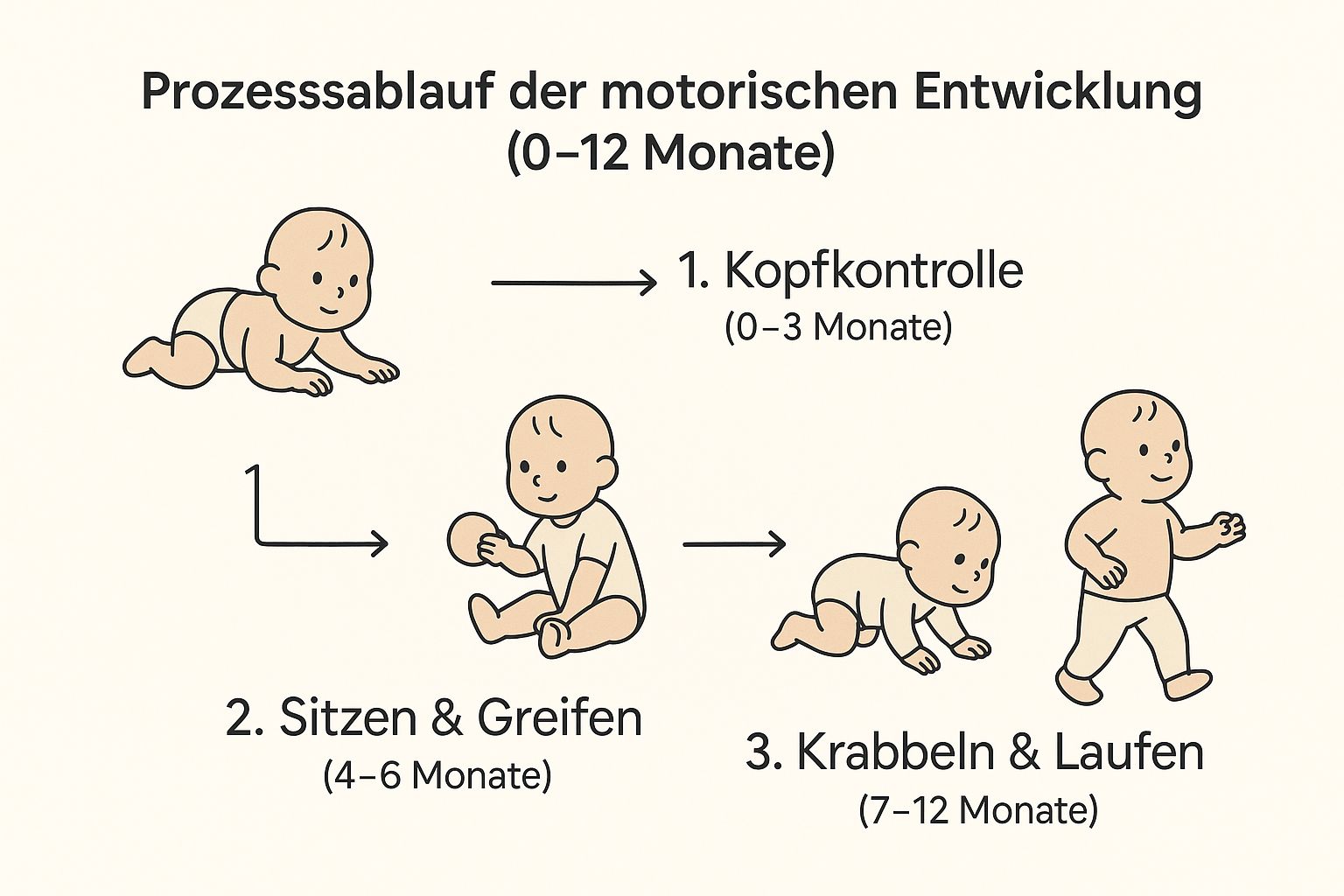
The three key phases are clearly visible: first head control ( 0–3 months ), then sitting and grasping ( 4–6 months ), and finally crawling and walking ( 7–12 months ). These foundations are the basis for everything that comes later – such as balancing or fine hand movements in kindergarten age.
To make it easier for you to get started, I have compiled a table with specific game ideas for indoors and outdoors.
Example weekly schedule for motor activities
This sample plan provides a structure that you can adapt to your child's needs, the weather, and their mood. It serves as inspiration for playfully integrating gross and fine motor skills into everyday life.
| weekday | focus | Indoor activity | Outdoor activity |
|---|---|---|---|
| Monday | Balance | to walk over a "carpet snake" (a rope or cloth) | Balancing on a tree trunk in the garden or park |
| Tuesday | Strength and coordination | Build a tunnel out of chairs and cushions and crawl through it. | Draw a hopscotch course in the yard using chalk. |
| Wednesday | fine motor skills | Thread beads onto a string using tweezers. | Fill a "nature discovery box" with sticks, leaves, and stones. |
| Thursday | balance | Set up an obstacle course with balancing stones | Try out a slackline in the park (stretch it low!). |
| Friday | Finger fitness | Shaping figures from modeling clay | Sort the collected sticks by size and thickness. |
| Saturday | Sensory perception | Barefoot path in the hallway with various sensory mats | Walking barefoot through the sand or across a meadow |
| Sunday | Creative joy of movement | Painting relay: Place a large sheet of paper on the floor and take turns painting. | Chasing and catching soap bubbles |
Remember: This plan is just a suggestion. Observe your child and find out what they enjoy most. Especially with children aged four to five and older, you can make the tasks a bit more challenging.
Tips for parents, kindergartens and therapy practices
For use in kindergarten, I often divided the activities into short units of five to ten minutes so they would fit well into the daily routine. Therapists, in turn, can use the plan as a structured supplement and specifically incorporate Flowfull sensory toys to increase their appeal.
"It is often the small, regular impulses that bring about lasting progress in motor skills," I explain again and again from my experience as a mother and expert.
A practical tip: Keep a "motor skills diary" to record small and large progress. It's incredibly motivating!
Here are a few quick ideas for implementation:
- Variety is key: Switch between indoor and outdoor activities to stimulate different senses.
- Keep the tension high: Vary the order of the exercises or invent new variations.
- Strengthen team spirit: Involve older siblings or other children as "helpers" or "role models".
You'll be amazed at how quickly everyday objects like cushions, benches or cardboard boxes can be transformed into an exciting movement landscape.
A simple routine for everyday life
To stay motivated, a simple routine can help. Try this:
- Start your mornings with a quick walk: Begin your day with a fast stroll along the barefoot path.
- Twice a week a highlight: Build a larger obstacle course with the balancing stones.
- End-of-week ritual: Repeat your favorite game at the end of the week – this will ensure a great sense of accomplishment.
This ensures that the learning activities remain varied and that the children continually discover new challenges. Adapt the plan to special occasions such as holidays, forest days, or creative projects.
For therapy teams, this structure offers a proven basis that can be expanded without much effort and whose results can be well documented and integrated into progress reports.
At the end of the week, it's worthwhile to celebrate the successes together. Ask the children what they enjoyed most. This way, you ensure that the joy of movement is always the focus.
What parents and professionals most frequently ask about motor skills
As the founder of Flowfull and a mother of two boys who can barely sit still for a minute, I constantly get asked the same important questions. Here, I share my experiences and provide practical answers so you can support your children's motor development from the age of three onwards without pressure and with lots of fun.
One of the most frequently asked questions is: "When do we actually start specifically promoting motor skills?" Experts agree that playful activities are ideal even at kindergarten age. As soon as children are around three years old, you can playfully train their balance, strength, and coordination using ordinary everyday objects.
But what if a child seems clumsy even though they play enough? There's often more to it than just clumsiness. Sometimes they lack sensory stimulation, or they're simply insecure. Limited movement experience can also be a factor. A closer look at their everyday behavior can often help identify the cause.
How do I get started and what do I need to pay attention to?
Many people think they need to train for hours. That's not true. In everyday life , 60 minutes of active, varied play is perfectly sufficient. The important thing isn't the length of time, but the variety. Simply switch between running wildly, calmly balancing, and targeted throwing. This way, you'll engage a wide range of muscles and senses.
Here are a few ideas that can be implemented immediately:
- Build an adventure course in the living room using pillows and blankets – this is pure training for gross motor skills.
- Thread beads together – this not only trains fine motor skills, but also concentration.
- Create a barefoot path with our sensory mats and let the little feet feel.
- Play simple throwing and catching games with a soft ball to improve hand-eye coordination.
Short, focused sessions have proven particularly effective in kindergartens and therapeutic settings. Five to ten minutes per "station" is perfectly sufficient to see lasting progress. Rotating the children in small groups also helps maintain their motivation.
My most important tip: Consistency is far more important than duration. It's better to be active for a few minutes several times a day than for an hour once a week. This will be much more effective in the long run.
The right toy for gross and fine motor skills
I often hear the question about the perfect toy that promotes both skills simultaneously. That's precisely why we developed our Flowfull blocks and cubes. With them, children can freely build, stack, and balance. Stacking the blocks requires both fine motor skills and a sense of stability. This creates a fantastic cycle of motivation: the higher the tower gets, the prouder the little builders are.
These modular sets are ideal for educators and therapists. They can be easily adapted to the age and abilities of the group. Four- to five-year-olds especially love the challenge of designing and building their own obstacle courses.
A great example from practice: In a kindergarten, we observed a group of five-year-olds as they constructed wobbly bridges using our Flowfull elements. You could literally see their coordination and self-confidence improve within a week.
Ultimately, every question is an opportunity to learn. With small, targeted prompts and the right materials, children from the age of three playfully become strong, confident, and self-assured.
I also offer an introductory workshop for kindergartens and medical practices. There, the teams can get hands-on experience, learn about the materials, and discover how versatile they are in promoting children's motor skills in everyday life.
A dynamic start to a confident life
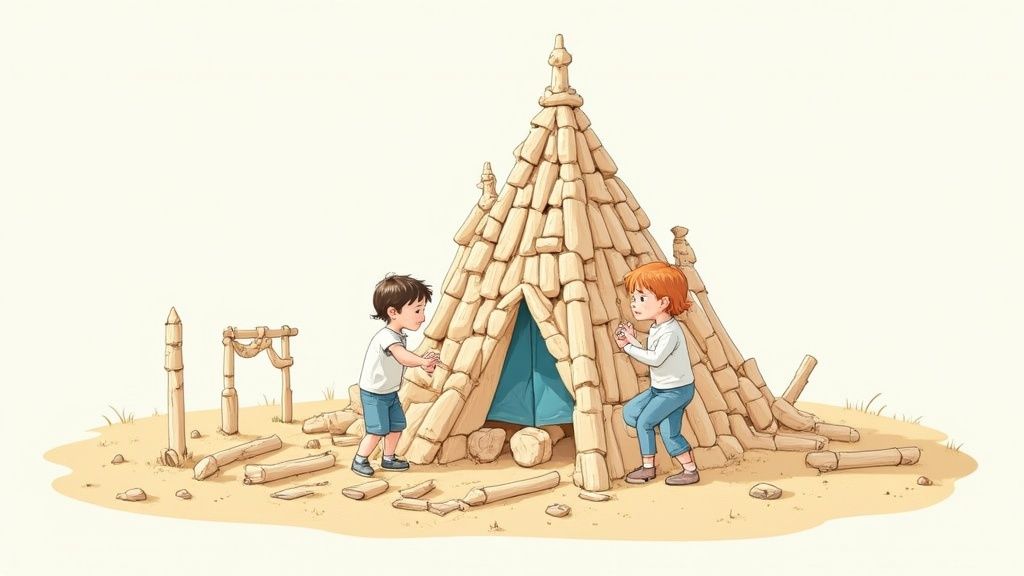
After all these practical tips and suggestions, I'd like to return to the heart of the matter. When we promote children's motor skills , it's never about peak performance or doing something perfectly. It's much more about the pure joy of movement, shared laughter, and the exciting journey of discovery into their own abilities.
Every little bit of progress is a huge win. Whether it's a wobbly tower of sofa cushions, a daring jump into a puddle, or the concentrated effort of threading a single bead – all of these are invaluable building blocks for healthy, holistic development. These moments are far more than just a pleasant pastime. They are essential training for body and mind.
More than just movement
As the founder of Flowfull, but above all as a mother, one thing is particularly important to me: Give your children the freedom and time they need for their development. Let them experience the world with all their senses – running barefoot across the meadow, digging their hands in the dirt, or balancing on fallen tree trunks. It is precisely in these moments that the crucial connections are formed in the brain, connections that are so important for coordination and a good sense of one's body.
Well-developed motor skills don't just strengthen muscles. They lay the foundation for so much more:
- Strong self-confidence: A child who learns to use their body safely and skillfully dares to do more. They simply go through life with more courage.
- Improved learning ability: It's no secret how closely motor and cognitive skills are linked. People who are physically fit often find it easier to concentrate.
- Emotional balance: Physical activity is a wonderful outlet for children. It helps them reduce stress and cope better with their feelings.
Always remember: The goal is not the perfect result, but the curious journey to get there. Every attempt, whether it succeeds on the first try or not, is an important learning experience for your child.
This is precisely the best start we can give our children. By creating an environment that encourages movement, we lay the foundation for a life full of self-confidence, curiosity, and the joy of discovery.
Would you like to provide your child with targeted yet playful movement opportunities at home, in kindergarten, or in therapy? Then take a look at Flowfull and discover our lovingly designed sensory toys. They invite children to develop their motor skills using all their senses.

