


Understanding and Lovingly Supporting Your Child's ADHD | A Guide from a Mother for Mothers
As the founder of Flowfull and a mother of two wonderful children, I know how it feels when you sense that your child perceives the world a little differently. ADHD isn't a matter of parenting. It's a neurobiological condition that often manifests in children, especially from the age of three, as a combination of inattention, hyperactivity, and impulsivity .

This guide is my attempt to offer you a helping hand – from one mother to another. My aim is to demystify the label "ADHD" and bring it out of the clinical, often cold, corner and into our real, sometimes chaotic, everyday family life. Together, we'll look at how we can lovingly support our children from the age of 3 – at home, in kindergarten, and in therapy.
What ADHD really means in my child's everyday life
I know the worries and questions surrounding ADHD firsthand. You ask your four-year-old to put on their shoes and find them five minutes later engrossed in playing with a ball of yarn, having completely forgotten about the shoes. Or you're sitting at the table eating and your child's legs are drumming incessantly under the table because sitting still seems impossible. These aren't moments of defiance, but often an expression of how a child with ADHD experiences the world.

My goal is not to impose a label on your child. Rather, I want to help you better understand the unique way your child perceives the world – especially during the crucial age of 3 and up .
Take a new perspective
For me, the turning point came when I understood: It's not about "fixing" my child. It's about creating an environment where they can fully develop their strengths. A child with ADHD is often incredibly creative, full of energy, and thinks in a way that never ceases to amaze us adults.
These qualities are true gifts, even if they sometimes push us to our limits in everyday life – whether at home or in kindergarten.
"Our task as parents is not to change the child, but to shape the world around it so that it can flourish. That is the essence of a supportive and loving approach."
Instead of focusing on the difficulties, we should learn to see the world through the eyes of our children. What might seem like pure chaos to us is often an expression of unbridled joy of discovery for them.
Practical support in focus
This article is not a dry treatise, but rather a practical guide – for you as mothers, but also for our partners in kindergartens and therapeutic facilities. I want to show you specifically how we can lovingly support our children's development and specifically foster their unique strengths. We will examine the underlying reasons for behavior and how we can respond without getting caught in an endless cycle of reprimands and frustration.
Together we will explore:
- Creating understanding: What actually happens in the brain of a child with ADHD?
- Developing everyday strategies: How can we create routines and structures that provide support and security?
- Boosting strengths: How do we discover and utilize the special talents that so often accompany ADHD?
You are not alone on this journey. Together we will find approaches that not only benefit your child, but also help the whole family to experience a more relaxed and joyful everyday life.
Recognizing typical ADHD signs in children aged 3 and older
As mothers, we often feel uncertain. Is this behavior still "normal" for a four-year-old, or is there perhaps more to it? The line between what is typical temperament for a preschooler and what could indicate ADHD often feels like a fine line.
I've always found it helpful to think not just in terms of clinical symptom lists, but to consider real-life situations. Does this sound familiar? You're in a hurry to leave, but your child suddenly starts making puppets out of their socks. Or the little fidget at the dinner table whose legs simply won't stay still, no matter what you say. Perhaps you're also familiar with the little whirlwind who, in a fit of pure enthusiasm, knocks over a newly built tower while playing with friends – without any malicious intent whatsoever.
It is precisely these moments that make us pause and reflect. It's less about isolated slip-ups and more about recurring patterns that make everyday life a real challenge for the child and the whole family.
The three core areas of ADHD
To better understand this behavior, it's incredibly helpful to take a closer look at the three main areas of ADHD. Think of them as three different "filters" through which your child perceives and interacts with the world.
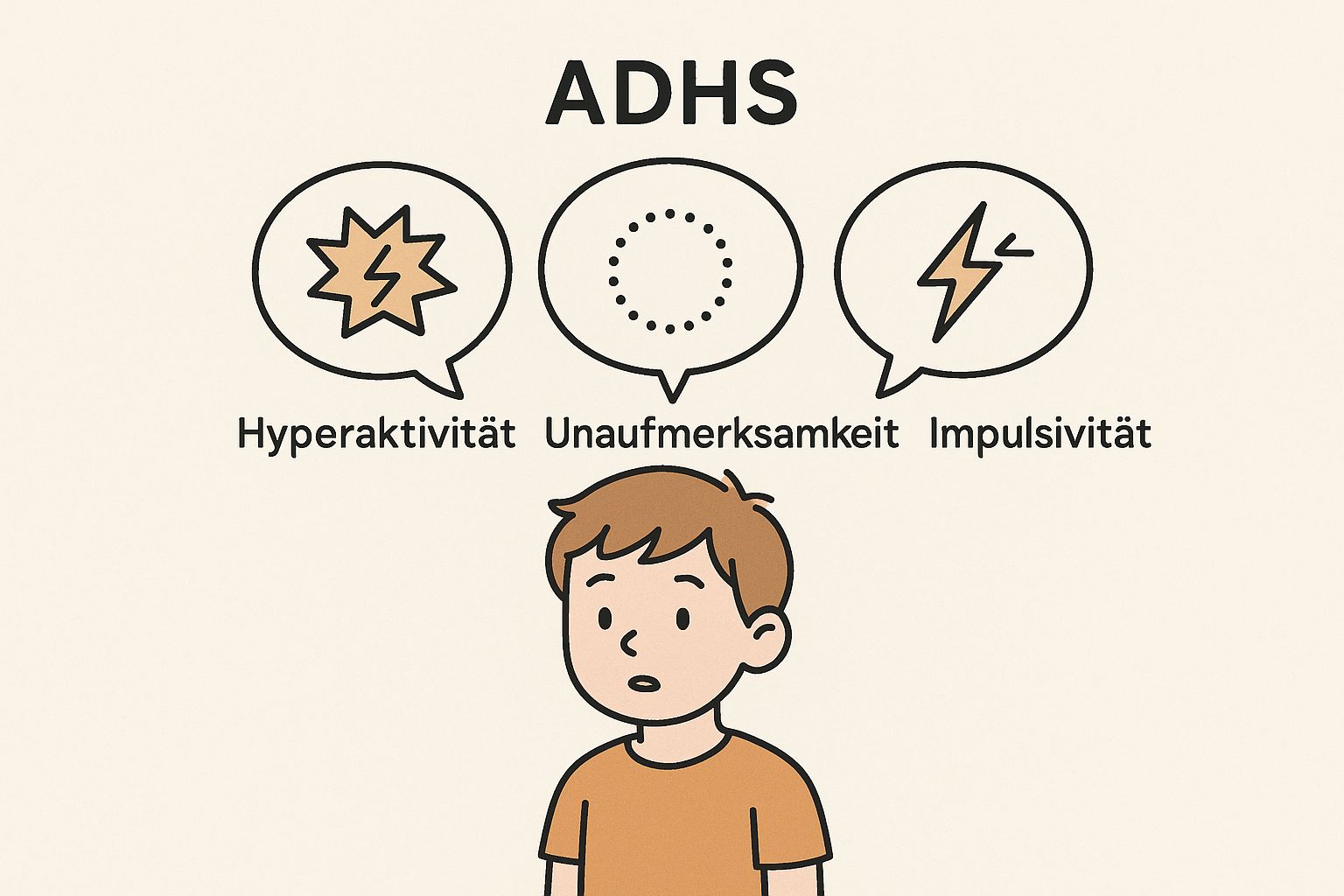
The graphic shows the three pillars that can shape behavior: inattention, hyperactivity, and impulsivity. Let's look at these areas with examples from everyday family life and kindergarten:
-
Inattention (The Little Dreamers): Your child seems to simply ignore an instruction, even though you are standing right in front of them. When reading a story aloud, their mind wanders after just two sentences, and they start talking about something completely different. A practical example: At kindergarten, your 4-year-old is supposed to hang up their painting to dry. They pick up the painting, but on the way there, they see the building corner and start building a tower – the wet painting is left forgotten on the floor.
-
Hyperactivity (The Little Balls of Energy): Sitting still is almost impossible. At the dinner table, they fidget in their chairs, climb on them, or eat standing up. During morning circle time at kindergarten, the child can hardly stay in their seat and fidgets so much that they disturb others. A practical example: While the other children are sitting in a circle listening to a story, your child suddenly gets up and runs around the room because their urge to move is simply too strong.
-
Impulsivity (The Little Volcanoes): Your child often acts before thinking. They blurt out an answer before the question has even been finished, or can barely stand waiting in line. A practical example: Another child is playing with a fire truck. Your child finds the truck fascinating, runs over, and takes it from the other child without asking. The impulse to have the truck was stronger than the rule to wait or ask.
It is very important to understand that this behavior is not malicious or disrespectful. It is an expression of a different way of processing information in the brain, which is often incredibly exhausting for the child.
Differentiation from typical toddler behavior
Every child between the ages of three and five is sometimes inattentive, boisterous, or impulsive. This is simply part of normal development. The crucial difference with a child with ADHD lies in the frequency, intensity, and impact on various areas of life—at home, in kindergarten, and when playing with friends.
A typical four-year-old might forget an instruction, but can usually refocus after a brief reminder. A child with signs of ADHD might be constantly distracted and barely manage to complete the task at all.
The following table can help to better classify behaviors.
Understanding behavioral patterns: typical development vs. possible signs of ADHD (ages 3-5)
This table helps parents and educators to distinguish normal, age-appropriate behavior from patterns that might indicate ADHD.
| Behavioral area | Typical behavior in 3-5 year olds | Possible sign of ADHD |
|---|---|---|
| Attention | Can stay focused for 5-10 minutes during exciting activities (e.g., reading a favorite book). | She is almost always and immediately distracted, even during favorite activities. |
| urge to move | Is very active, has a lot of energy, but also needs rest periods. | Is almost constantly in motion, climbs on furniture, and can hardly sit still even when tired. |
| impulsiveness | Has difficulty waiting, interrupts adults, wants things immediately. | Reacts extremely strongly and immediately, snatches toys from other people's hands, constantly interrupts conversations. |
| Social play | They are just learning to share and follow rules; conflicts are normal. | Constantly clashes with others because rules are disregarded or the physical reaction is too intense. |
| Dealing with rules | It tests boundaries, but needs clear and repeated instructions. | Seems to ignore instructions, even after repeated, calm explanations. |
This comparison is of course not a diagnosis, but it can provide initial guidance and help to sort out one's own observations.
Statistics show that these observations are relevant for many families. In Germany, approximately 5% of children and adolescents are affected by ADHD. Interestingly, the diagnosis is significantly more common in boys. You can find more information about the prevalence and distribution in studies such as the KiGGS study on the website of ADHS Deutschland e.V.
If you recognize these patterns in your child, you are not alone. It is the first, important step towards better understanding your child and finding ways to support them lovingly and effectively.
Understanding the true causes of ADHD
One of the most agonizing questions I hear from other mothers, and one that plagued me for a long time, is: "Did I do something wrong?" I want to put your mind at ease right away: No, you didn't. ADHD is not the result of parenting mistakes, a lack of love, or poorly set boundaries. This assumption is outdated and has long been scientifically disproven.
As a mother, I know how deeply these feelings of guilt can run. That's why it's so important to me that we look at the true, scientifically proven causes. Understanding this was the key for me to approach my child with compassion instead of frustration.
An orchestra in the head
Imagine your child's brain as a large, vibrant orchestra. For it to become a wonderful symphony, it needs a conductor to give the cue, set the tempo, and ensure that all the instruments play together harmoniously. In a child with ADHD , this conductor—the ability to self-regulate and filter stimuli—is sometimes simply overwhelmed.
This means that the "musicians"—that is, all the thoughts, impulses, and sensory impressions—often play simultaneously and without clear instructions. A loud, chaotic jumble ensues, making it incredibly difficult to concentrate on a single melody.
This neurobiological peculiarity means that the brain processes information differently. It's not a question of wanting to, but of being able to. Your child is truly doing their best to cope with this inner chaos.
This difference in brain function is not imaginary. Studies show that certain neurotransmitters, such as dopamine and norepinephrine, which are crucial for attention and impulse control, interact differently in children with ADHD. This disrupts the smooth communication between the brain regions responsible for planning, organization, and action control.
The role of genetics
Another crucial factor lies in genetics. ADHD has a strong hereditary component. The likelihood of a child developing ADHD increases significantly if a parent or close relative is also affected.
What this means for you in concrete terms:
- It's innate: The predisposition for ADHD was essentially placed in your child's cradle.
- It's not a question of upbringing: Neither too much television nor a particular diet is the cause. Such factors can sometimes intensify or lessen symptoms, but they are never the trigger.
- Focus on support: Instead of looking for someone to blame, we can fully concentrate our energy on creating an environment in which our child can thrive.
The processing of sensory input plays a crucial role. A brain that struggles to distinguish between important and unimportant information is constantly bombarded with stimuli. Our article on sensory integration in children provides more information on how you can help your child better manage these stimuli.
Internalizing this knowledge is an incredibly liberating step. It relieves us as parents immensely and creates the foundation to give our child exactly the support they need to learn to conduct their wonderful, unique orchestra in their head.
How an ADHD diagnosis is made in children
As a mother, you know that moment of uncertainty when you sense that there might be more to your child's behavior. The thought of a diagnosis is often frightening at first. But from my own experience, I can tell you: it can also be an incredible relief. Finally, the whole thing has a name, and you can provide targeted and loving support.

It is important to me to alleviate any concerns you may have about this process. A proper ADHD diagnosis is never a "quick fix" or a simple test that can be completed in half an hour. Quite the opposite: it is a comprehensive, very careful process in which your child, as a whole person, is the focus.
Who makes the diagnosis and what exactly happens?
The process usually begins with a visit to the pediatrician. He or she is the first point of contact to share your observations and get an initial assessment. If the suspicion is confirmed, you will be referred to specialists.
The actual diagnostic procedure then takes place at one of these locations:
- Child and adolescent psychiatrists: These are doctors who specialize in the mental health of children and adolescents.
- Child and adolescent psychotherapists: These are psychologists with special additional training who are also allowed to make diagnoses.
- Social Pediatric Centers (SPZ): In these centers, entire teams from different disciplines (doctors, psychologists, therapists) work hand in hand.
A good diagnostician will always take plenty of time for you and your child. It's about understanding how your child behaves in a wide variety of situations – not just in the doctor's office, but also at home, in kindergarten, or on the playground.
A sound diagnosis is like a puzzle. Each piece – your observations, the educators' assessment, playful tests, and conversations – contributes to a complete and clear picture.
This thorough process ensures that nothing is overlooked. The experts also need to rule out other possible reasons for your child's behavior. These could include, for example, undetected hearing or vision problems, but also other emotional stressors or developmental delays.
The building blocks of a comprehensive diagnostics
Professional diagnostics are always "multimodal"—a technical term that simply means that information is gathered from many different sources. The following components are typically combined over several appointments:
1. Detailed interviews (anamnesis): Here, you are the expert on your child. We'll discuss your history, your observations, your child's development from birth, and the family situation. Your perspective is invaluable!
2. Standardized questionnaires: Both you and the kindergarten teachers will be asked to fill out questionnaires. This may sound bureaucratic, but it helps the professionals to objectively assess and compare the child's behavior in different environments.
3. Behavioral observation and play-based testing: The diagnostician observes your child directly, usually during play or while solving small, age-appropriate tasks. They pay particular attention to concentration, impulsivity, and motor restlessness. Especially with a four-year-old child with ADHD, this is naturally done in a very sensitive and playful manner.
4. Physical examination: A doctor makes sure that there are no physical causes behind the symptoms, just to be on the safe side.
The importance of this careful process is also demonstrated by the public debate surrounding the prevalence of ADHD. While health insurance data occasionally suggested an increase in diagnoses, the figures in large scientific studies have remained relatively constant. This underscores how crucial accurate diagnosis is to avoid misdiagnoses and truly improve children's quality of life. You can find more information about the background of this debate, for example, at the Robert Koch Institute .
The path to diagnosis is therefore not a label, but the starting point for understanding your child even better and giving them exactly the support they need. It creates clarity – for you, your child, and everyone who accompanies them on their journey.
Practical strategies for family and kindergarten
Once an ADHD diagnosis is confirmed, the most important part of our journey as mothers begins: creating a loving and supportive environment for everyday life. I know from personal experience how overwhelming this can be. That's why I want to offer you a kind of toolbox here – full of strategies that have proven effective not only in our family life but also in our work with kindergartens and therapists.
It's not about following a rigid plan. Rather, we want to adapt the environment so that your child with ADHD feels safe, understood, and capable. For me, the three most important pillars for this are quite clear: reliable structures, positive reinforcement, and communication on equal terms.
Clear structures as a safe haven
Imagine your child's brain is like an orchestra, where each musician plays their own piece – fascinating, but chaotic. Predictable patterns are like a conductor, bringing calm and order to the proceedings. Structures provide support, reduce constant sensory overload, and offer security because your child knows exactly what to expect next. This is an enormous relief for their mind.
And this is what it can look like in concrete terms:
- Visual daily plans: A simple plan with pictures or pictograms for the morning (getting up, getting dressed, having breakfast, brushing teeth) can work wonders. Your child can see at a glance what needs to be done. This works just as well at home as it does as a morning routine board in kindergarten.
- Designated places for important items: The kindergarten backpack has its hook on the coat rack, the shoes are always in the same spot. It sounds trivial, but it drastically reduces the morning search chaos.
- A quiet retreat: Create a small, cozy corner – without noisy toys or screens. A snug hideaway with blankets, pillows, and perhaps noise-canceling headphones is a blessing when the world gets too loud. Here, your child can calm themselves without feeling excluded.
Remember: Structure is not about strictness. It is a loving guidepost that helps your child find their way in a complex world and become more independent.
Such visual aids and clear routines are not only invaluable for families. They are also a central element in the educational work in daycare centers. They help educators provide orientation and security to an entire group of children with a wide variety of needs.
Positive reinforcement as a driver for self-esteem
Children with ADHD constantly hear what they should n't do: "Stop fidgeting!", "Listen!", "Don't be so wild!". Over time, this severely damages their self-esteem. Positive reinforcement reverses this vicious cycle. We consciously focus on what's going well and give that behavior our full attention.
This doesn't mean you should praise your child to the skies for every little thing. It's about honest and, above all, specific recognition.
- Praise the process, not just the result: Instead of a general "Great picture!", say something like: "I saw how persistently you painted this picture. That certainly wasn't easy!"
- Give clear and immediate feedback: If your child manages to sit quietly at the table for five minutes, tell them right then and there: "Wow, you're doing a really great job!"
- Use reward systems: For recurring challenges like getting dressed in the morning or tidying up, simple boards with stickers can be incredibly motivating. The reward should ideally be something shared – an extra story read aloud or a trip to the playground together.
This approach strengthens inner motivation and sends the most important message of all: "I can do it! I am good just the way I am."
Clear communication and the power of self-regulation
An overstimulated brain can barely process complex instructions. Long sentences and convoluted requests simply get lost. That's why clear, concise, and direct communication is so crucial. Break large tasks down into small, manageable chunks.
Instead of: “Please tidy your room, get dressed and get your shoes, we have to leave soon!”
Try this: "First, please gather all the Lego bricks into the box." Once that's done, the next step is: "Great! Now please put on your jacket." And finally: "Excellent, now all you need are your shoes."
This "one-step-at-a-time" approach prevents overwhelm and ensures small but important successes.
A particular focus of our work at Flowfull is on promoting self-regulation – the ability to control one's own feelings and impulses. Sensory aids play an invaluable role here, as they help the nervous system to calm down and refocus.
Our Flowfull kinetic sand trays are designed precisely for this purpose. The gentle trickle of sand through the hands, the shaping and building, has an almost meditative effect. It provides a meaningful outlet for the inner urge to move and helps the child transition from a state of high tension to a state of calm concentration. Read more in our magazine about how to find the right sensory toy for your child.
These tools are ideal for use at home, but also for our partners in kindergartens and therapy practices. They offer children a constructive way to deal with their inner restlessness, process emotions, and refocus on a task. They are the best proof that we don't need to change the child, but can give them the right tools so they can help themselves.
Recognize and foster your child's strengths
Let's conclude by taking a different perspective together. ADHD is just one part of your child; it doesn't define who they are. As a founder and mother, I wholeheartedly want to encourage you to discover the special gifts that so often accompany the perception of a child with ADHD .
Because behind all the hustle and bustle and apparent unrest, true treasures are often hidden. Many of these children possess almost limitless creativity, impressive resourcefulness, and an energy that could move mountains. They often think outside the box and thus find solutions that others would never come up with.
Don't adapt the child, adapt the environment
The key to a more harmonious family life often lies not in trying to change the child, but in creating an environment that meets their needs. It's about establishing a loving, understanding framework in which they can develop and flourish. As we've seen, clear structures, positive reinforcement, and the right sensory tools are incredibly valuable in this regard.
This is not a sprint, but a marathon. Studies show that approximately 60% of affected children still experience symptoms into adulthood. This underscores the importance of early, supportive intervention that builds upon the child's individual strengths. You can find more information about these long-term perspectives at ADHS Deutschland e.V.
“Instead of clipping a child’s wings to fit into our small box, we should teach them how to fly with their unique wingspan.”
With understanding, patience, and the right strategies, every child can learn to cope with their challenges and fully develop their unique talents. This is a process that constantly challenges us as parents, but also as educators, to remain flexible and explore new approaches.
This positive and resource-oriented approach is precisely why educators and therapists recommend Flowfull . It's about giving children tools that allow them to better understand and regulate themselves, and to freely express their creativity.
Finally, I'd like to leave you with this thought: You are not alone. With plenty of love, the right knowledge, and the courage to focus on your child's strengths, they can reach their full potential. Trust in yourself and in the uniqueness of your wonderful child.
Frequently asked questions about ADHD in children
As a mother, I know from personal experience that after all the information, very specific, practical questions often remain unanswered. That's why I've compiled the most frequently asked questions that I encounter time and again, and answer them briefly and concisely, directly from practical experience for practical application.
Does ADHD simply go away with age?
In short: No, not really. ADHD is a neurobiological characteristic that lasts a lifetime. What changes dramatically, however, is how we deal with it. Your child doesn't "grow out" of their ADHD, but rather learns to cope better and better with their individual strengths and challenges.
Particularly noticeable hyperactivity often subsides during adolescence and adulthood. However, difficulties with attention and organization can persist. This is precisely why early support and learning effective strategies are so incredibly important – they lay the foundation for an independent life.
Is medication an option for a 4-year-old child?
This question is very sensitive and must always be discussed individually with an experienced child and adolescent psychiatrist. However, as a general rule, non-pharmacological therapies have absolute priority for preschool children, i.e., those aged approximately three to five years .
The focus here is clearly on other things:
- Behavioral therapy: Here your child learns in a very targeted way to strengthen their social and emotional skills.
- Parent training: As parents, you will receive the necessary tools to better structure everyday life for your child and the whole family.
- Targeted support: Occupational therapy and especially sensory offerings like those from Flowfull are invaluable in helping your child learn to better feel and regulate themselves.
Medication is only considered at this young age in extremely severe cases and after very careful consideration. The very first step is always to create an environment and daily routine that allows the child to develop in the best possible way.
What is the best way to talk about my child's ADHD in kindergarten?
The key is an open and respectful conversation with the educators. Don't go there with a "list of problems," but with the goal of finding solutions together. Explain objectively what the ADHD diagnosis means for your child's everyday life and how it makes your child feel.
A great icebreaker is to start by talking about what works well at your home. Share the little tricks and strategies that help your child calm down or stay focused on something.
Offer very specific suggestions that might also be implemented in kindergarten. This makes it tangible and feasible for the educators.
For example, you could suggest:
- Clear, concise instructions: Ask for instructions to be given in small, understandable steps, rather than saying everything at once.
- Movement breaks: Can your child briefly stand up or carry something heavy to get rid of their excess energy?
- A quiet retreat: Is there perhaps a cozy corner or a small tent where your child can retreat when things get too much?
Believe me, most professionals are incredibly grateful for such insights and tips. It helps them truly understand your child and give them the support they need. Together, you can create a space where your child feels safe and can showcase their strengths.
Imagine seeing your child engrossed for hours in a game that not only entertains but truly promotes development – without chaos, without frustration.
As a mother, that's exactly what I wanted for my own children: to playfully support their development, awaken their senses, and prepare them for the world.
But what about reality?
The market is flooded with toys that are either too complicated, too messy, or simply unsustainable. It was frustrating to find products that are safe, educational, and practical for everyday use – not sandboxes that ruin the floor or plastic sets that break easily.
That's exactly why I founded Flowfull: to offer parents like you a real alternative.
Our sit-in sensory box with creative cubes made from sustainable larch wood is more than a toy – it is a clean, foldable world of discovery.

Children aged 3 and up immerse themselves in tactile adventures:
Grasping, pouring, sorting – without dust or mess. Antibacterial, washable, and weatherproof – perfect for home, daycare, or therapy. It promotes fine motor skills, concentration, and sensory integration while you relax and watch.
Ready to bring this magic into your everyday life? Try our Flowfull ® Sensory Box – visit our shop and discover endless fun.
But don't just let me tell you – listen to what the experts say:
Experienced educators and therapists share their real success stories with our cube bath here:
Expertise that inspires: Flowfull® sensory toys put to the test
How it captivates children for hours, creates moments of calm, and boosts development. From Saskia Wedel, early childhood educator: 'The Flowfull cube sandbox is a wonderful addition to my parent-child groups. The children explore it with such curiosity and concentration – wonderful flow moments are created.' Such testimonials have inspired and validated us.

