


7 DIY sensory play ideas using Flowfull® creative cubes that you can use right at home
Want to make your own sensory toys? Absolutely! As Julia, founder of Flowfull and a mother of two, I know you don't need much. You can playfully promote the development of children from around 3 years old using simple everyday items. It's about creating intense sensory experiences that specifically stimulate fine motor skills, concentration, and creativity.

Why sensory play is so important for your child's development
I see every day with my own children how important it is to give them the right stimuli for their development. Come along, I'll take you into the fascinating world of sensory play and show you how you can create amazing play worlds with our Flowfull® creative cubes and a few household items.
This is about so much more than just keeping your child occupied. When your child feels different textures, sorts by color, or builds towers, they are specifically strengthening their skills – and having a lot of fun in the process.
The hidden superpower in the game
Every time your child handles and experiments with different materials, something magical happens in their brain. New neural pathways are formed, and these form the basis for all later, more complex learning processes. These playful activities lay the foundation for skills like writing, arithmetic, and problem-solving.
Sensory play specifically promotes these areas:
- Fine motor skills: Grasping small cubes, pouring rice or kneading dough is great training for the small muscles in the hands and fingers.
- Cognitive development: Children learn basic mathematical concepts almost incidentally through sorting, comparing, and counting. They recognize patterns and playfully understand the principle of cause and effect.
- Language development: When we play together, we automatically name colors, shapes, and sensations. "The cube feels rough," "The water is cold"—this is how our vocabulary grows naturally.
- Emotional regulation: Focusing completely on one thing can be incredibly calming. Many children find sensory play a way to unwind, reduce stress, and relax.
From knowledge to trying it out at home
More and more parents, as well as kindergartens and therapists, are recognizing the value of these early sensory experiences. It's no wonder, then, that DIY sensory toys are becoming increasingly popular in Germany. Montessori consultants confirm that products like sensory boxes, which focus on feeling and touching, are incredibly popular with families. Many mothers tell me how their children can spend hours playing with these homemade play worlds – leading to genuine relaxation and significantly improved concentration.
It's simply incredible to watch how a simple tray with some sand and a few wooden blocks can captivate a child for what seems like an eternity. These moments of deep concentration are pure gold for brain development.
Targeted support for sensory integration in children is key to healthy development. This involves processing and organizing all the sensory information received by the senses in the brain. DIY sensory toys are a wonderful tool to support this process in a loving and playful way.
The ideal basis for your DIY game worlds
Before we get really creative and look at ideas for your homemade sensory toy , I want to introduce you to the centerpiece for countless play worlds: the Flowfull® Creative Cubes. When I developed them, I had a clear vision: to create a toy that sparks the imagination instead of channeling it into predetermined paths.
Our wooden building blocks are deliberately kept simple. This is precisely their great strength, as they are the perfect, open canvas for all kinds of play scenarios and sensory experiences.
What makes our dice so special?
As a mother, I know that good toys have to do more than just look colorful. They have to feel good, they have to be safe, and above all, they have to encourage exploration. Our creative cubes combine exactly these qualities.
- The feel of natural wood: There's nothing quite like the sensation of real, smoothly sanded wood in your hand. The cubes have a pleasant weight, a natural warmth, and a fine grain – that alone is a wonderful sensory experience.
- Carefully chosen colors: The colors are naturally water-based, saliva-resistant, and completely safe for children. We deliberately chose them to encourage sorting and matching without being too bright or overwhelming.
- A universal shape: A cube can be anything. A building block for a castle, a treasure in the sandbox, an ingredient in a play kitchen, or simply an object for counting and stacking. This simple shape gives endless scope to the imagination instead of restricting it.
Our cubes follow the principles of Montessori pedagogy. They are a classic example of "open play material" that allows children to learn and discover completely independently and at their own pace. There is no right or wrong here, only endless possibilities.
The true magic happens when a child takes a simple block of wood and, in their imagination, creates something completely unique. That is self-directed learning in its purest form.
It's precisely this simple ingenuity that makes the cubes the perfect foundation for all the DIY ideas we're about to look at. You can combine them beautifully with sand, water, rice, playdough, or natural materials, creating new and exciting toys time and time again. They're the perfect starting point for countless little adventures.
Do you want to create this foundation for creative and sensory play at home? Discover the Flowfull® Creative Cube Set now and lay the groundwork for creative learning!
Seven creative ideas you can implement immediately
Okay, now it's time to get practical! As a mom, I know from experience: the best ideas are the ones you can implement quickly and easily. That's exactly why I've gathered my seven favorite play ideas for your DIY sensory toys . They're all based on our versatile Flowfull® Creative Cubes , but of course, they can be adapted.
So, make yourself comfortable, maybe with a cup of coffee, and let yourself be inspired!
1. The tactile and sensory path in the living room
This idea is our absolute lifesaver on rainy afternoons. We simply transform the living room floor into an exciting barefoot sensory path. The Flowfull® cubes serve as colorful signposts from one station to the next.
What you need:
- A few Flowfull® creative cubes
- Flat trays, baking trays or open cardboard lids
- Various materials to feel: uncooked rice, dried lentils, soft pom-poms, sand, some cool water, or even just crumpled paper.
And it's so easy: Fill each of the different materials into one of the bowls. Then arrange the bowls in a row to create a small "street." Place a creative cube in a specific color next to each sensory station. Your child can now tiptoe from bowl to bowl, feeling the many different textures with their feet and learning through play.
2. Sort colors in the sand
A simple box of play sand or even a large bowl of semolina can be transformed into an archaeological dig site in no time. This exercise is not only incredibly fun, but it also incidentally trains color recognition and hand-eye coordination.
What you need:
- A box of play sand or semolina
- Flowfull® Creative Cubes in various colors
- Small shovels, spoons, or simply the hands
And it's so easy: Bury the colorful cubes in the sand. Now your child can go on a treasure hunt, dig up the cubes, and sort them by color. If you'd like to add a little challenge, place small "islands" of colored construction paper outside the box where the found cubes can be collected.
My practical tip: To make it a bit more challenging, give your child a small pair of tongs or tweezers. Precisely grasping the cubes is fantastic training for the pincer grasp – a skill that will be absolutely essential later when learning to write.
3. Recreate the pattern using natural materials
A simple walk in the woods or park becomes an exciting treasure hunt! With this idea, you bring a piece of nature directly into the children's room and combine the clear, geometric shapes of cubes with the organic structures of leaves, sticks, and stones.
What you need:
- Flowfull® Creative Cube
- What nature provides: small stones, acorns, leaves, short twigs, chestnuts
- A large tray or a piece of cardboard as a base.
And it's so easy: Use the creative cubes to lay out a simple pattern or shape – a snake, a house, a square, anything goes. Your child's task is then to recreate this pattern using the collected natural treasures. It's always fascinating to see how focused the little ones are on finding the right shape and arrangement.
This image beautifully illustrates how simple the creative process can be.
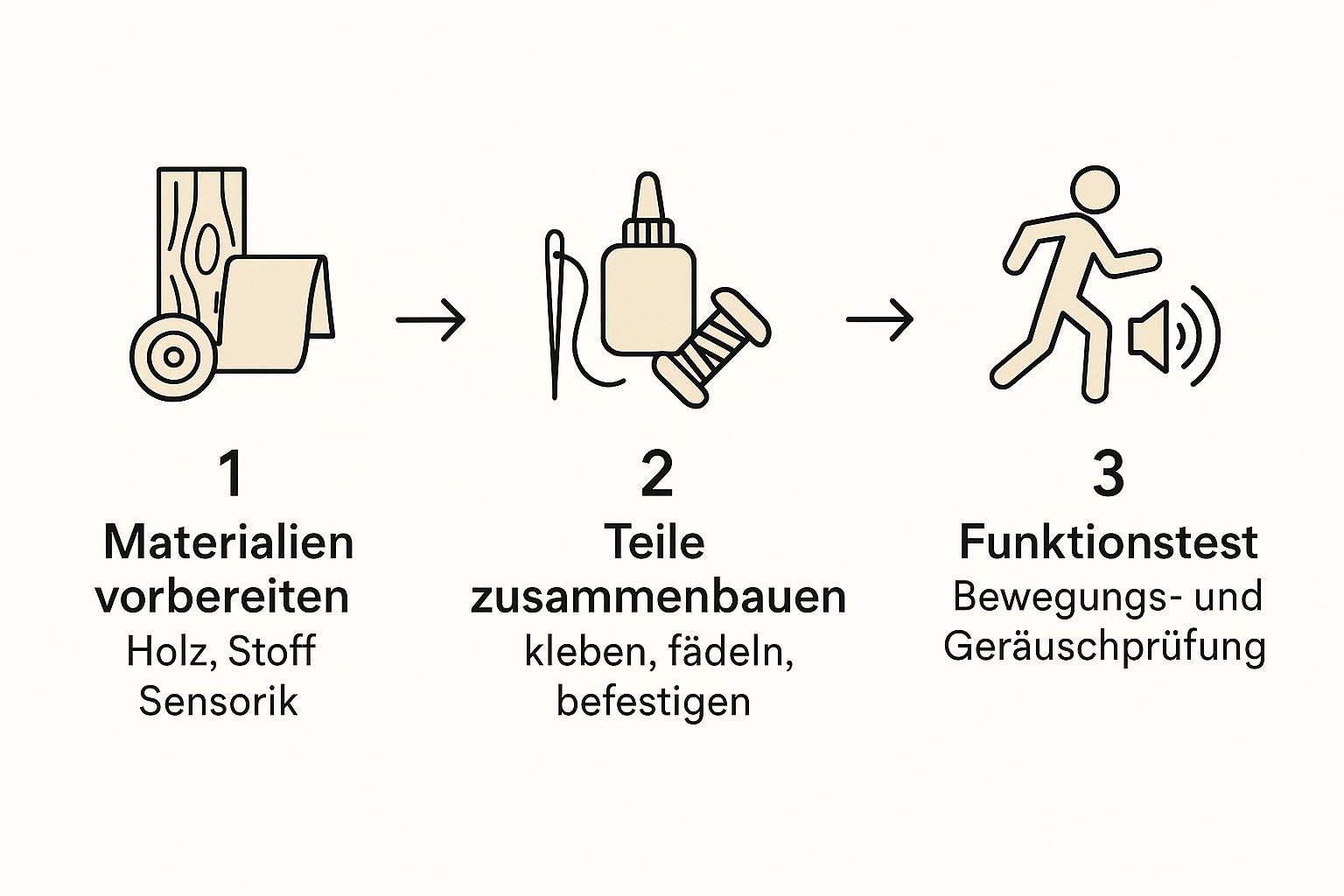
From gathering the materials to the finished game, every single step is a valuable experience for your child.
4. The Great Ice Cube Rescue Operation
Water is simply a brilliant sensory element. Especially on warmer days, this game idea offers a welcome refreshment and an exciting little experiment all in one.
What you need:
- Flowfull® Creative Cube
- An ice cube tray large enough for the cubes
- Water
- Some warm water in a bowl, pipettes or small squeeze bottles
And it's so easy: Place a cube in each compartment of the ice cube tray, fill it with water, and put it in the freezer. Once everything is frozen solid, the rescue mission can begin! Your child's task is to free the cubes from the ice. This works perfectly by dripping warm water onto them with a pipette. A great game to promote patience and an early understanding of physical processes.
5. Building and balancing with modeling clay
Play-Doh is and always will be a classic in children's rooms. But have you ever combined it with wooden blocks? This opens up completely new building and play possibilities that take fine motor skills and spatial reasoning to a new level.
What you need:
- Flowfull® Creative Cube
- Play dough in various colors
And it's so easy: Your child can use small balls of modeling clay as "mortar" to connect the cubes. This creates towers and figures that would immediately fall over without the clay. Another great variation: Roll the clay out into flat patties and let your child press the cubes into them to make imprints. Or you can use the clay as a wobbly base on which the cubes have to be carefully balanced.
Here is a brief summary of the ideas to give you a quick overview.
Overview of 7 DIY sensory ideas
A quick overview of the presented game ideas, the skills promoted, and the materials required.
| Game concept | Primary sensory experience | Primarily promotes | Required additional materials |
|---|---|---|---|
| 1. Sensory path | Sense of touch (feet) | Sensory integration, body awareness | Shells, rice, lentils, sand, water, etc. |
| 2. Color sorting in sand | Sense of touch (hands), sight | Color recognition, fine motor skills, hand-eye coordination | Sand/semolina, shovels, pliers (optional) |
| 3. Patterns with natural materials | Sense of touch, sight | Creativity, shape recognition, fine motor skills | Stones, leaves, sticks, acorns, etc. |
| 4. Ice cube rescue | Sense of touch, sight | Patience, basic understanding of physics, fine motor skills | Ice cube tray, water, pipettes |
| 5. Building with modeling clay | Sense of touch, proprioceptive perception | Fine motor skills, spatial reasoning, creativity | Play dough |
| 6. Sound Memory | Hearing, sense of touch | Auditory perception, memory | Small containers, rice, lentils, bell peppers, etc. |
| 7. Play of light and shadow | See | Creativity, understanding of light/shadow | Flashlight, darkened room |
This table is meant to serve as inspiration. The possibilities are virtually endless, and often the best ideas arise directly while playing with your child.
How to customize the game safely and individually
As a mother of two, one thing is crystal clear to me: safety always comes first. Even the most brilliant play idea is only good if we can calmly supervise our little ones. That's why this part is a real priority for me before you start making your own sensory toy .
Precisely because we're handling such a wide variety of materials here – from tiny lenses to water – careful supervision is absolutely essential. This is especially true if there are younger siblings in the house, who, as we all know, tend to put small parts in their mouths.
Safety first – my golden rules
Before the fun begins, I always briefly go through these points in my head. This gives me the reassurance that everything is in order and we can fully concentrate on the shared experience.
- Choose materials carefully: Make sure that all items you offer are non-toxic and suitable for children's hands. For foods like rice or lentils: These are play materials, not snacks.
- The "toilet paper roll rule": A super simple trick! Anything that fits through an empty toilet paper roll is a potential choking hazard for children under three. Keep this in mind if younger siblings want to join in the fun.
- Create a clear playing area: A tray with high sides or a large box is incredibly helpful in keeping materials where they belong. This not only minimizes chaos but also the risk of slipping on scattered lentils.
- Playing together: Especially with new materials or a completely new game setup, your presence is invaluable. This allows you to guide, observe, and gently intervene if necessary.
Here's how to adapt the game to your child.
Every child is unique – and that's what makes it so wonderful! What one child finds absolutely fascinating can quickly overwhelm another. The greatest strength of homemade sensory toys lies precisely in this: you can perfectly tailor them to your child's individual needs and preferences.
Perhaps you have a child who loves visual stimuli. Then you could, for example, use colored rice or have them sort the Flowfull® Creative Cubes according to the rainbow principle. Other children, however, are very sensitive to certain textures. If your child, for instance, hates sticky hands, you might prefer to start with dry sand or smooth stones instead of going straight to playdough or slime.
It's not about creating a Pinterest-perfect play world. It's about giving your child a space where they feel comfortable, can be curious, and receive exactly the stimuli they need for their current development.
Trust your instincts and observe your child closely. You are the expert on your child and know best what is good for them. If you would like to delve deeper into the subject, you will find further valuable information about the basics of sensory toys in our magazine.
By making the game safe and personalized, you create the best conditions for valuable and relaxing gaming moments.
Sensory toys in daycare centers and therapy: A look from practice
As the founder of Flowfull, it's a tremendous joy for me to see how our creative cubes are not only conquering children's bedrooms, but have also become a staple in daycare centers and therapy practices. This confirms what we've long observed: In professional settings, there's a need for play materials that are versatile and, above all, adaptable. And that's precisely where a homemade sensory toy can often offer the flexibility that professionals need for their important work.
In the hectic daily routine of a daycare center or a focused therapy session, materials need to do more than just be pedagogically valuable. They need to be robust, easy to clean, and versatile. This is where wooden toys like our Flowfull® cubes demonstrate their true potential.
Flexible for educational plans and therapy goals
For educators, it is essential to create activities that seamlessly integrate into the curriculum. The DIY ideas we have presented can be easily adapted to the specific group size and learning objectives.
- In a group setting: A "sensory trail" can be wonderfully set up as a station-based activity for several children. This also promotes teamwork and communication among them.
- In individual therapy: An occupational therapist could use "sorting colors in the sand" to specifically train a child's fine motor skills and concentration. The level of difficulty can be perfectly tailored to the individual's developmental needs.
The cubes are inherently open-ended. This opens up countless possibilities for developing new variations that specifically address areas such as language, early mathematical understanding, or social skills. If you'd like to delve deeper into how to create such activities at home, take a look at ourguide to sensory play at home .
Durability and hygiene – what matters in everyday life
Where many little hands are at work, the quality of the material and easy cleaning are crucial. Our wooden cubes are made precisely for this: robust and durable. Unlike many plastic toys, they easily withstand intensive use. And the best part? They can be easily wiped clean with a damp cloth – a huge advantage in the hectic daily routine of a daycare center.
In professional applications, the focus is on working efficiently and conserving resources. A high-quality base material that can be constantly reinvented is invaluable here. It saves not only money but also valuable preparation time.
Sensory play is increasingly coming into focus in educational institutions. It is estimated that 70–80% of institutions already consciously use sensory toys to specifically support children with very different needs. DIY projects are becoming particularly popular, as they are individually adaptable and support early childhood development in a very cost-effective way. Further interesting insights into the importance of developmental toys can be found at bildungsberatung-stmk.at .
The enormous versatility of our Flowfull® creative cubes makes them an ideal tool for anyone who professionally supports children in their development.
One last thought from me to you
I hope these DIY sensory toy ideas have sparked your imagination and inspired you to get started right away. As a mother and founder, it's important to me to share something personal with you at the end.
Don't see these instructions as rigid rules, but rather as a starting point. They are an invitation to feel the materials, see the colors, and make the toy truly your own. It is this process, the shared tinkering and laughter, that creates the truly precious memories.
We accompany our children on their journey of development, and we do this best with love, patience, and plenty of play. Our Flowfull® creative cubes are meant to be a faithful companion, but the magic only comes from you – from your ideas, your curiosity, and the time you spend together with your child.
Every child is an artist. The difficulty lies in remaining one as an adult. This very philosophy is embodied in each of our dice.
So, go for it! Get creative, try new things, and most importantly, have fun. Show us what wonderful things you've created and share your creations on social media with the hashtag #FlowfullKreativ . Let's build a community together that inspires each other and celebrates the joy of creative play.
Now it's your turn! Grab your Flowfull® creative cubes and share your game ideas with us!
Questions that parents and educators often ask

I frequently receive similar questions from parents and kindergartens regarding the DIY sensory toy using our cubes. I've compiled the most important ones here to help you quickly and easily.
From what age are the DIY ideas suitable?
We deliberately developed the Flowfull® creative cubes and the play ideas in this article for children aged 3 and up . At this age, their fine motor skills are more developed and the risk of swallowing small parts is significantly lower.
Of course, the following still applies: never leave your child unattended, especially when playing with small objects like lentils, beads, or rice. Safety always comes first.
How do I clean the wooden cubes after the game?
Luckily, it's incredibly easy! Usually, it's enough to simply wipe the wooden cubes clean with a slightly damp cloth after playing.
A little tip from experience: Never completely submerge the dice in water or use harsh cleaning agents. The wood is a natural material and could swell or be damaged. Let them air dry, and they'll be ready to use again.
Can I combine other materials with the dice?
Yes, absolutely! That's precisely the beauty of the open-ended play concept. The Flowfull® creative cubes are like a blank canvas. They practically invite you to combine them with anything you can find in your toy box or in nature.
Whether you use chestnuts from your last walk, colorful fabric scraps or homemade playdough – there are absolutely no limits to your imagination.
Are you ready to create your own game worlds? At Flowfull you'll find the perfect, safe and sustainable foundation for doing so.
Discover the Flowfull® creative cubes now at flowfull.de

