


The science behind focused play: How sensory engagement improves concentration
Hello, I'm Julia, the founder of Flowfull and mother of two wonderful children. Do you know those moments? The ones when, as a parent, you long for nothing more than for your child to play completely absorbed and happy for a while? The science behind what we call "Sensory Play" offers a fascinating explanation: Targeted sensory experiences build precisely the neural pathways in the brain that are essential for concentration and successful learning in children from the age of three.

The magic of focused play
Let's dive into the exciting world of sensory play together. In this article, as a mother and founder, I'll show you the science behind it and how these sensory experiences shape the brains of children from the age of three. We'll explore how they sustainably strengthen concentration and bring little ones into that wonderful state known as "flow."
This is about so much more than just a short-term distraction. We're talking about fundamental development that optimally prepares children from the age of 3 for the demands of kindergarten and later, school.
This article is your personal compass as a mother. It aims to help you consciously and joyfully guide your child's development based on sound scientific principles. It marks the beginning of a journey that lays the foundation for a lifetime of curiosity and a thirst for learning.
What does that mean specifically for your child?
Imagine your child letting sand trickle through their fingers or intently pouring water from one cup to another. What looks like a simple activity is actually a firework display in the brain.
- New pathways in the brain: Every single sensory stimulus – the feeling of cool sand, the lapping of water – triggers neurons to fire. In this way, countless new connections are formed and strengthened in the brain. This is learning in its purest form.
- Training the "attention muscle": When a child becomes fully absorbed in a captivating activity, they unconsciously train their prefrontal cortex. This is the area of the brain responsible for our focus and impulse control.
- An anchor in a storm of emotions: Sensory play often has an incredibly calming effect. It helps children process strong emotions, reduce inner restlessness, and regulate themselves.
It is precisely these moments of deep, almost meditative concentration that we at Flowfull aim to create. Our Flowfull set was designed specifically to provide children aged 3 and up with a stimulating yet calming play environment. Discover our set here and support your child in naturally finding this valuable state of flow.
What exactly is sensory play?
Sensory play, often also called "sensory play," is essentially any activity that specifically stimulates your child's senses. We mothers usually think of the classic five: touch, sight, hearing, smell, and taste. But the concept goes much deeper and also includes the sense of balance (vestibular) and body awareness in space (proprioceptive).
Imagine your four-year-old letting warm sand trickle through their fingers, listening to the gentle lapping of water, or intently sorting differently shaped wooden blocks. Each of these actions is so much more than just a pleasant pastime – it's a veritable firework display of signals in the brain.

Laying the foundation for learning
These signals are crucial because they build new neural pathways and strengthen existing ones. I like to compare it to creating new paths in untouched landscapes: the more often a path is used, the wider and more stable it becomes. This is exactly what happens in your child's brain with every sensory experience.
This phase is particularly crucial for children from the age of three, as their brains are especially receptive to new stimuli at this age. The science behind Sensory Play shows that these experiences lay the foundation for more complex skills such as reading, writing, and logical thinking. It's about not just looking at the world, but truly "grasping" it.
Sensory play is about establishing a direct connection between action and result. A child learns: "If I tip the cup, the water flows out." These simple insights are fundamental lessons about cause and effect.
The importance of this form of play is also well-researched in Germany. For example, the KOMPAN Play Institute defines sensory play as activities that activate all of a child's senses. One of their studies shows that approximately 85% of children aged 3 to 7 in Germany have regular access to sensory-stimulating playgrounds, which demonstrably promotes their social interaction and cognitive skills. You can read the fascinating research findings directly from the KOMPAN Play Institute .
From stimulus to meaningful information
Sensory play is the driving force behind so-called sensory integration . This is the brain's ability to organize and filter all the different sensory impressions and combine them into meaningful information. Without this ability, the world would be an overwhelming chaos of sounds, lights, and feelings.
A child who plays with different textures such as slime, sand, or water trains their brain to process stimuli and respond appropriately.
- Tactile perception: The child learns the difference between rough and smooth, warm and cold, soft and hard.
- Visual perception: It recognizes colors, shapes and patterns and can categorize them.
- Proprioceptive perception: It senses how much force it needs to exert to lift a block or pour water.
This ability to process multiple sensory stimuli simultaneously is a huge step in a child's development. If you'd like to delve deeper into this topic, I recommend our guide to sensory integration in children . There, I explain in detail how this process works and why it's so important.
5 Reasons for Sensory Play: The Science Behind It
Why should we, as mothers, educators, or therapists, consciously integrate sensory play into our children's everyday lives? As a mother of two, I've heard this question often. The answer lies not only in the obvious fun of play, but deep within developmental biology. Science provides us with clear and fascinating reasons that demonstrate how fundamental this type of play is for children from the age of three.
1. It accelerates brain development
Every time your child reaches into a box of sand, hears water splashing, or feels different shapes, something amazing happens in their brain. Each sensory stimulus triggers an electrical signal that travels back and forth between nerve cells, the neurons. This activity strengthens existing connections and creates entirely new ones.
You can imagine the brain as a vast, ever-expanding road network. Every sensory experience is like building a new road or a new highway on-ramp. The more routes there are and the more often they are used, the faster and more efficiently information can be transported. Sensory play is therefore the most direct and effective training for making this neural network denser and more powerful.
2. It perfects fine motor skills
Do you remember the first time your child deliberately reached for a small object? This seemingly simple movement requires incredibly complex coordination between eyes, hands, and brain. Pouring rice, sorting small stones, or kneading dough are highly effective exercises for developing precisely these fine motor skills.
These skills are not just child's play. They are direct preparation for everyday, but important tasks such as holding a pen, tying shoelaces, or using cutlery safely. By offering children a variety of sensory materials, we give them the perfect tools to playfully develop their motor skills.
3. It trains the concentration muscle.
Concentration is like a muscle – it needs regular exercise to become strong. One of the biggest challenges for children (and often for us adults too) is blocking out the countless distractions and focusing completely on one thing. This is where sensory play proves to be a true master.
The fascinating nature of materials like sand, water, or slime almost magically attracts a child's attention. They become completely absorbed in their activity and, for a moment, completely block out the outside world.
This state of deep concentration, also known as "flow," is crucial. In this state, the brain learns to self-regulate and to consciously direct its attention – a skill that is invaluable for success in school and later in life.
4. It supports emotional regulation.
Have you ever noticed how calming the gentle sound of sand trickling or the feeling of warm water on your skin can be? Sensory activities have a strong regulating effect on our nervous system. For children, whose emotional world can often be turbulent and overwhelming, such games offer a safe haven in the chaos of everyday life.
Kneading soft dough or repeatedly pouring lentils can help reduce stress, process frustration, and alleviate inner restlessness. In this way, children learn how to calm themselves in a very intuitive and physical way – one of the most important skills for a balanced and resilient life.
This infographic clearly shows which key sensory systems are particularly stimulated during sensory play.
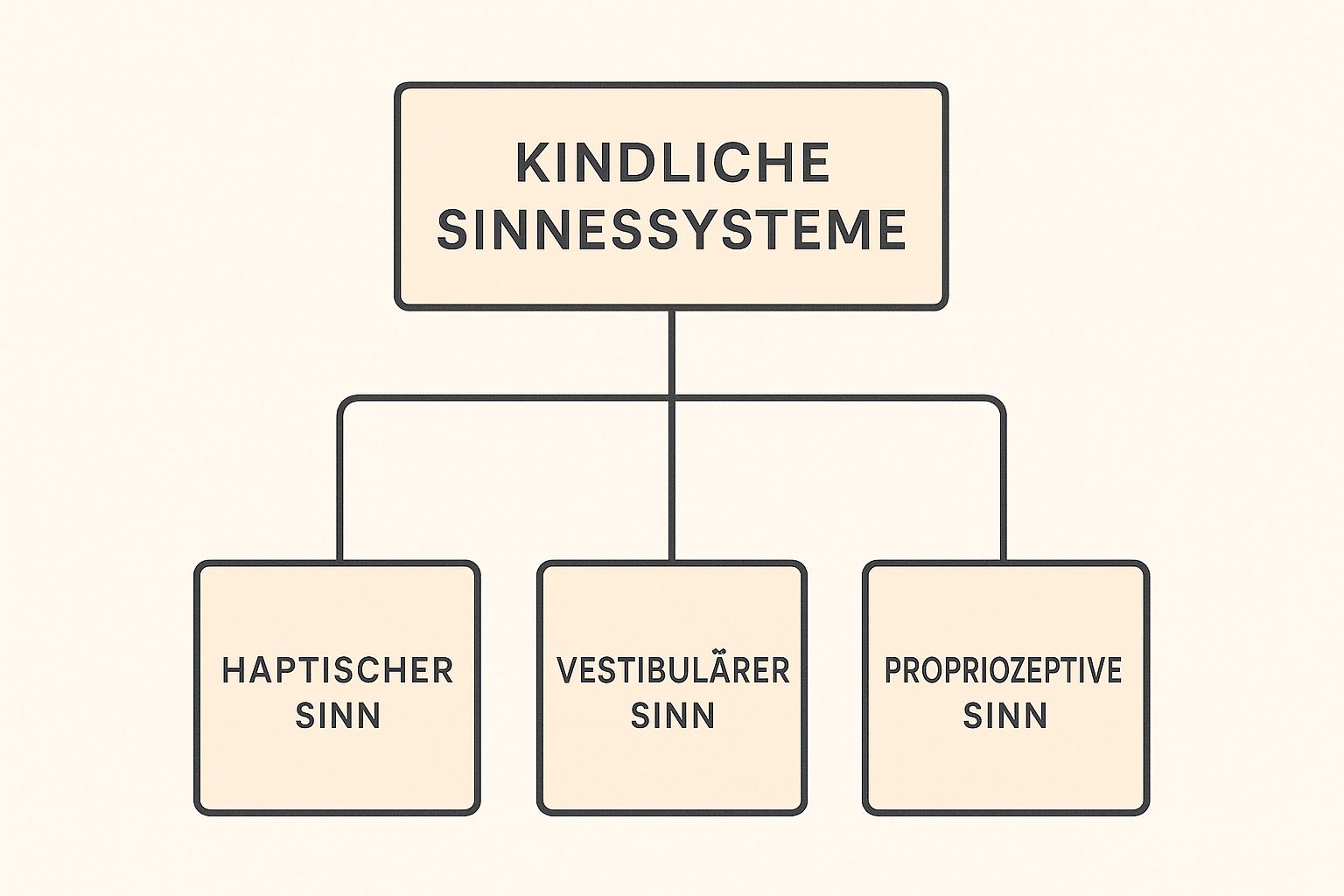
Here you can clearly see that, in addition to the well-known five senses, the sense of touch (haptic) , the sense of balance (vestibular) and body awareness (proprioceptive) play a key role.
5. It promotes language and social skills
Sensory play is rarely a silent activity. When children play and experiment together, they naturally describe what they are doing and feeling. "Look, my tower is really tall!" or "The slime feels so funny and slippery."
Two things happen simultaneously:
- Language development: The children actively expand their vocabulary. They learn new terms for textures (rough, smooth), shapes (round, angular) and actions (pouring, kneading, sorting).
- Social skills: They have to coordinate, exchange ideas, negotiate ("Can I have the spoon too?") and find compromises. This is social learning in its purest form.
The following table summarizes the most important advantages for you in a clear and concise manner.
Overview of the 5 advantages of Sensory Play
This table summarizes the five key developmental areas that are promoted through targeted sensory play in children aged 3 and over.
| Advantage | Scientific justification | Practical example |
|---|---|---|
| Brain development | Every sensory stimulus creates and strengthens neuronal connections, making the brain more efficient. | A child feels different surfaces (soft, rough, cold) and the brain processes this information. |
| fine motor skills | Complex hand-eye coordination is trained through targeted, repeated movements. | A 4-year-old child picks and sorts small beads or lentils with their fingers. |
| concentration | Fascinating materials capture attention and train the brain to block out distractions. | A child who is completely absorbed for 15 minutes pouring water from one container to another. |
| Emotional regulation | Rhythmic, repeatable sensory activities have a calming effect on the nervous system. | Kneading play dough after an exciting or stressful day at kindergarten to calm down. |
| Language & Social Skills | Experiencing and describing sensory impressions together promotes vocabulary and interaction. | Two children play together with sand and water, describe their "constructions" and share the molds. |
As you can see, there's a whole lot of science behind the seemingly simple act of "squishing".
Studies impressively confirm this: Children under six years of age who participate in targeted sensory play activities for at least 30 minutes daily show up to 25% better results in tests of motor coordination and language development.
If you'd like to get started right away, our guide to sensory play at home offers plenty of practical ideas to easily put these insights into practice.
A look inside your child's brain while playing
Have you ever wondered what's actually going on in your child's mind when they're completely absorbed in playing with sand or pouring water from one cup to another? From a neurobiological perspective, it's a real firework display. It's so much more than just a pleasant pastime – it's an intense workout for the most important areas of the brain.
For example, when a child feels the rough texture of sand, their somatosensory cortex is working at full capacity. This area is, so to speak, the brain's sensory center, processing touch, pressure, and temperature. Each of these stimuli is registered here, sorted, and transformed into understandable information.

The brain learns to focus.
At the same time, another crucial area is also engaged: the prefrontal cortex . It can be thought of as the brain's "CEO" or control center. It is responsible for all the demanding tasks such as planning, decision-making, controlling impulses, and, above all, directing attention.
Sensory play trains this control center in a crucial skill: the targeted blocking out of distractions. The brain learns to concentrate fully on a single, captivating activity. We know this state from science as "flow"—and for a child, it is not only incredibly fulfilling but also extremely educational.
You can really think of it as a gym for the mind. Each round of sensory play specifically trains the neural "muscles" for attention and focus. This ability for self-regulation is one of the most important foundations for later success in school.
What science says about it
Research impressively confirms this connection. Neuropsychological studies at Ludwig Maximilian University of Munich show that regular sensory play is directly linked to improved processing performance in the somatosensory cortex. A study with over 300 children yielded a remarkable result: children in sensory play programs had a 15% lower rate of attention deficit disorders and showed a 20% faster development of their fine motor skills. Those wishing to delve deeper into these fascinating findings can find more information in the research conducted at LMU Munich.
In plain terms, this means that sensory play is not a short-term sedative. It sustainably shapes and strengthens the brain's architecture. It lays the foundation for a brain that has learned to self-regulate and stay focused on a task.
How the Flowfull Set supports this process
This is precisely where Flowfull comes in. We've used these scientific findings to create a play environment that specifically stimulates this learning process. The Flowfull set is more than just a collection of toys. It's a carefully curated tool that provides exactly the right stimuli to bring your child's brain into an optimal state for learning and concentration.
The various materials and tools are carefully selected to awaken natural curiosity and invite the child to immerse themselves deeply in play. Discover the Flowfull Set here and give your child the perfect learning environment where they can develop their concentration skills in the most beautiful way: through play.
Practical game ideas for improved concentration
So, after all that theory about neurons and synapses, you're probably wondering: How do I put all of this into practice at home? Don't worry, it's much easier than it sounds, and the possibilities are truly endless. The trick is to create an inviting environment that encourages exploration without overwhelming the senses.
Just get started. You don't need complicated setups. Often, a simple box or a shallow tub filled with different materials is enough to spark your child's curiosity and draw them into deep, focused play.

Simple ideas to get started
To make it easier for you as a mother to get started, I've compiled some of my favorite sensory activities here. These are absolute hits with my own children and in the daycare centers we work with.
-
The classic rice or lentil box: Fill a tub with plain or colored rice, dried lentils, or chickpeas. Provide spoons, cups, and small scoops. Pouring, digging, and rearranging the contents is incredibly calming and fantastic for developing the fine motor skills of a four-year-old.
-
The nature discovery table: On your next walk, simply collect what nature provides: soft feathers, rough pine cones, smooth stones, rustling leaves. Arrange everything in a box and let your child explore the different textures and shapes with all their senses.
-
Water games for little explorers: A tub of water is a classic that never gets old. Spice things up by adding sponges, different containers for transferring the water, sieves, or even a few drops of food coloring. This way, children playfully learn about basic physical principles.
A crucial factor for successful sensory play is the environment. Create an atmosphere with as few distractions as possible. This means: no television, no loud music, and not too many other toys around. Only then can your child fully engage with a single sensory experience and immerse themselves in that valuable "flow" state.
A well-thought-out solution for focused play
From my own experience as a mother, I know that everyday life is often hectic and there's little time for elaborate preparations. That's precisely why we developed the Flowfull Set . It takes the hassle out of searching for the right materials and offers a thoughtfully curated selection of tools specifically designed to guide children aged 3 and up into deep, focused play.
With the practical tub as a safe play base and the lovingly selected accessories, you have everything you need for countless play ideas right at hand. It's the perfect tool to specifically promote concentration and make the science behind Sensory Play directly tangible for your child.
Discover now how our Flowfull Set can unleash your child's creativity and concentration, and effortlessly create valuable play moments.
Game themes for advanced players
If your child has already gained experience with simple sensory boxes, you can expand the play ideas thematically. This not only promotes concentration but also stimulates imagination and encourages role-playing.
- The construction site: Fill the tub with sand or small pebbles. Add small construction vehicles, wooden blocks, and stones. Your child can build roads, dig holes, and transport materials.
- The Dinosaur Landscape: Blue jelly becomes a prehistoric lake, cocoa powder becomes soil, and broccoli florets become trees. Small dinosaur figures can populate this prehistoric world and experience adventures.
- The Ocean World: Dye water blue and add shells, glass pebbles, and plastic sea creatures. This creates a fascinating underwater world that invites sorting, counting, and storytelling.
These themed worlds are not only ideal for the home. They are also a fantastic tool for kindergartens and therapeutic facilities to convey learning content playfully and with all the senses.
Flowfull for kindergartens and therapists
The magic of sensory play isn't confined to the nursery at home. It's an invaluable tool in professional settings – whether in the bustling kindergarten or the focused atmosphere of an occupational therapy practice. It's so much more than just a pleasant pastime. From my experience as a founder and mother, I know exactly what matters: play materials must meet the high standards of professionals.
Early childhood educators know the daily challenge all too well: guiding a whole group of children with very different personalities, needs, and developmental stages. This is precisely where thoughtfully designed sensory play becomes a real game-changer for group dynamics. It creates spaces where individual developmental needs can be addressed in a targeted and playful way.
A tool for targeted support
In therapy, especially in occupational therapy, sensory play is the bridge to the child. It helps young children to better sort and process stimuli, find their own self-regulation, and gradually reduce motor insecurities. Therapists can thus work on a very intuitive, nonverbal level and truly and sustainably stimulate a child's development.
The science behind Sensory Play provides the foundation for this. It's not about random handling, but about providing targeted sensory input. These impulses stimulate the nervous system and help the brain build new, more efficient connections.
For professionals, one thing is crucial: they need materials that are not only pedagogically valuable, but also safe, durable, and extremely versatile. A good tool adapts to the needs of the children, not the other way around.
With precisely this idea in mind, we developed our Flowfull Set . From the outset, it was designed to more than meet the high demands of everyday professional life. It's not just a toy, but a well-thought-out system that promotes child development.
- Robust and safe: All components are designed for intensive, continuous use and meet the highest safety standards. This is simply a must in a daycare environment.
- Flexible and versatile: The set can be easily adapted to a wide variety of therapy goals and educational concepts – from promoting fine motor skills to supporting emotional regulation.
- Easily integrated into everyday life: It helps professionals to incorporate scientifically sound support approaches into their daily work without lengthy preparation time.
At Flowfull, we see ourselves as a partner for educational and therapeutic institutions. Our goal is to provide you with high-quality tools that enable you to optimally support the development of each individual child. Many experts in these fields are already using them successfully. Read in our magazine why educators and therapists recommend Flowfull .
We therefore offer special rates and personalized consultations for kindergartens, schools, and therapy practices. We firmly believe that focused, sensory play is key to healthy child development. We want to support you in making the best possible use of this key.
Discover the many possibilities that the Flowfull Set offers for your facility and request your individual offer for our B2B partners.
Frequently asked questions about sensory play
As a mother and founder, I receive countless questions daily from parents, as well as educators and therapists. While the topic of sensory play is incredibly fascinating, it understandably also raises some uncertainties. Therefore, I have compiled and answered the most frequently asked questions here to give you even more confidence and enjoyment on your journey with focused play.
At what age does sensory play really make sense?
I hear this question all the time. And the answer is a bit twofold. Basically, sensory experiences begin right at birth – every touch, every sound is a sensory stimulus for a newborn. But when we talk about targeted, prepared sensory play, that is, playing with materials in a bathtub, then it unfolds its full potential from about the age of three .
Why then? Well, children of this age have the motor skills to handle the materials safely. Crucially, the oral phase, in which everything is explored with the mouth, is usually over. Most importantly, their brains are now perfectly prepared to process these complex stimuli and transform them into lasting learning. The science behind Sensory Play shows us that it is precisely during this phase that the essential foundations for concentration and impulse control are established.
How long should a game session last?
There's no stopwatch or fixed rule here, because your child will give you the best answer. As a rough guideline, a playtime of 15 to 30 minutes has proven effective. This is long enough to really immerse themselves in the game and achieve that wonderful flow state, but short enough to avoid overwhelming them.
The key lies in observation. Is your child calm and visibly engrossed? Perfect, just let them be. But as soon as they become restless, lose interest, or start throwing materials around wildly and inappropriately, that's a clear signal: their mental capacity is full. Then it's time for a break or a completely different, more physically active activity.
Regularity is more important than duration. Fifteen minutes of focused play every day is better than one full hour once a week. This way, the brain is continuously trained, and the positive effects can unfold most effectively.
How can I avoid overstimulating my child?
That's a perfectly valid concern. Overstimulation occurs when the brain receives more stimuli than it can process at that moment. The child then often becomes fussy, hyperactive, or withdraws completely. The good news: You can consciously and easily prevent this through sensory play.
The golden rule here is quite clear: less is more.
- Limit the choice of materials: It's best to start with just one basic material (for example, sand) and two to three simple tools like a spoon and a cup. Ten different textures at once would only overwhelm the child.
- Create a calm environment: Ensure a low-stimulus atmosphere. No television on, no loud music in the background. The focus should be solely on feeling, pouring, and experiencing.
- Pay attention to the signals: Every child has a different threshold for stimulation. Observe your child's body language carefully. A relaxed, focused child is fully engaged in learning. A frantic or frustrated child is signaling that they need a break.
Is the Flowfull set suitable for my child?
The Flowfull set was designed from the ground up for children aged three and up. It's essentially the answer to all the questions mentioned above, as its design is specifically aimed at preventing overstimulation and encouraging deep, focused play. The tub creates a clear, defined play area that provides a sense of security. The carefully selected tools are precisely tailored to the motor skills and cognitive development of this age group.
It provides a safe yet stimulating environment to experience the science behind Sensory Play right in your own home. It's the ideal tool for all parents who want to consciously support their child's development without extensive preparation.
I hope this article has given you a glimpse into the fascinating world of sensory play and shown you what a valuable gift you can give your child. At Flowfull, we firmly believe that focused play is the key to happy and healthy development.
Discover the Flowfull Set now and give your child the joy of deep, focused play.


