


144 children prove: This is why your child gets so wound up in the evening
New study reveals - it's NOT your fault ( and the solution is simpler than you think )

The hidden problem behind the unrest
Children today are exposed to significantly more stimuli than previous generations. Screens, noise, packed schedules – their young nervous systems are constantly running at full throttle.
A day in your child's life:
- 7:00 AM: Wake up to music/radio
- 8:00 a.m.: Breakfast with conversations and hectic activity
- 9:00-12:00: Daycare/School - 25 other children, noise, learning
- 1:00 PM: Lunch in a noisy environment
- 2:00-4:00 PM: Activities, playground, dates
- 4:00 PM - 6:00 PM: Often still screen time
- 6:00 PM: EXPLOSION
What happens neurologically? When the brain is overstimulated, it switches to "fight or flight" mode. The prefrontal cortex—responsible for impulse control—shuts down. The child CANNOT calm down. It's neurologically impossible.

The tragic irony: the more tired children become, the more cortisol (stress hormone) they produce. Cortisol blocks melatonin (sleep hormone). The result? Hyperactivity instead of sleep.
You know the symptoms:
- Crying over little things
- Outbursts of anger out of nowhere
- Can't sit still
- "Mom, I'm bored" - even though there are 100 toys available.
- Trouble falling asleep despite exhaustion

You've tried everything: routines, rules, rest periods, less sugar. Nothing works permanently.
Why? Because the solution lies elsewhere.
What 144 children showed science
In February 2024, researchers published a groundbreaking study in "Frontiers in Education." 144 children between the ages of 3 and 6 were tested – with astonishing results.
The study compared:
- Traditional toy (only one sense is activated)
- Multi-sensory toy (engages multiple senses simultaneously)
The result was clear:
Children playing with multi-sensory toys showed:
- Longer periods of concentration (significantly more engagement time)
- Improved learning outcomes (improvements in all test areas)
- More consistent gameplay (less distraction, more flow)

The researchers explain: "The synergy between the senses is particularly important in early childhood, where sensory experiences form the basis for complex cognitive functions."
What experts from the field confirm:
"In my 20 years of experience as an early childhood educator, I have rarely encountered a material that is so versatile. The antibacterial properties of the wood make it hygienically safe - unlike beans, which have to be replaced after a short time."
- Laura Zehnpfund, Head of Early Intervention, Lebenshilfe Harzkreis-Quedlinburg
The breakthrough:
The study identified EXACTLY which sensory elements are most effective:
1. Proprioceptive input (weight & pressure): When children feel weight, it activates the parasympathetic nervous system - the part responsible for rest.
2. Tactile Stimulation (Touch & Texture) The right texture - not too smooth, not too rough - keeps children focused longer than any digital game.
3. Defined Boundaries (Structure in Chaos): Children need freedom AND structure. Too much freedom overwhelms them. Too much structure bores them.

The parents' dilemma
Now you know: Multi-sensory play works. Scientifically proven. 144 children can't be wrong.
But here's the problem:
In therapy: Perfect conditions
- Professional equipment for €5,000
- Bean pits, sand baths, water tables
- Trained care
- Therapy setting
At home: The chaos
- Bean pit: Day 1 great, Day 14 mold
- Kinetic sand: Scattered everywhere, never to be cleaned up again
- Water tubs: Flooding guaranteed
- Rice/Lentils: "Mom, can we eat this?"

The missing puzzle piece:
There was no solution that:
✗ Scientifically sound AND practical for everyday use
✗ Multi-sensory AND clean
✗ Therapeutically effective AND affordable
✗ It is structured AND freely playable
The researchers of the study themselves emphasized: "Future research should focus on developing toys that are not only appealing and effective, but can also be adapted to the diverse educational needs of children."
That's exactly what Julia and Gil Lang did...

The Flowfull® sensor system: The application of science
When Julia and Gil saw the power of sensory play in their children's occupational therapy, they had no idea that they would develop exactly what science would later demand.
Her story begins like yours: Two exasperated parents. Chaos every evening. Then, in occupational therapy, the epiphany: 45 minutes of focused play in a beanbag. Pure peace.
"Why does this only work here?" Julia asked the therapist. "The material is too impractical for home use. Beans get moldy, sand makes a mess..."
They did not accept this answer.
Two years of development. Twelve prototypes. Countless tests with their own children. The goal: Therapy quality for everyday life.
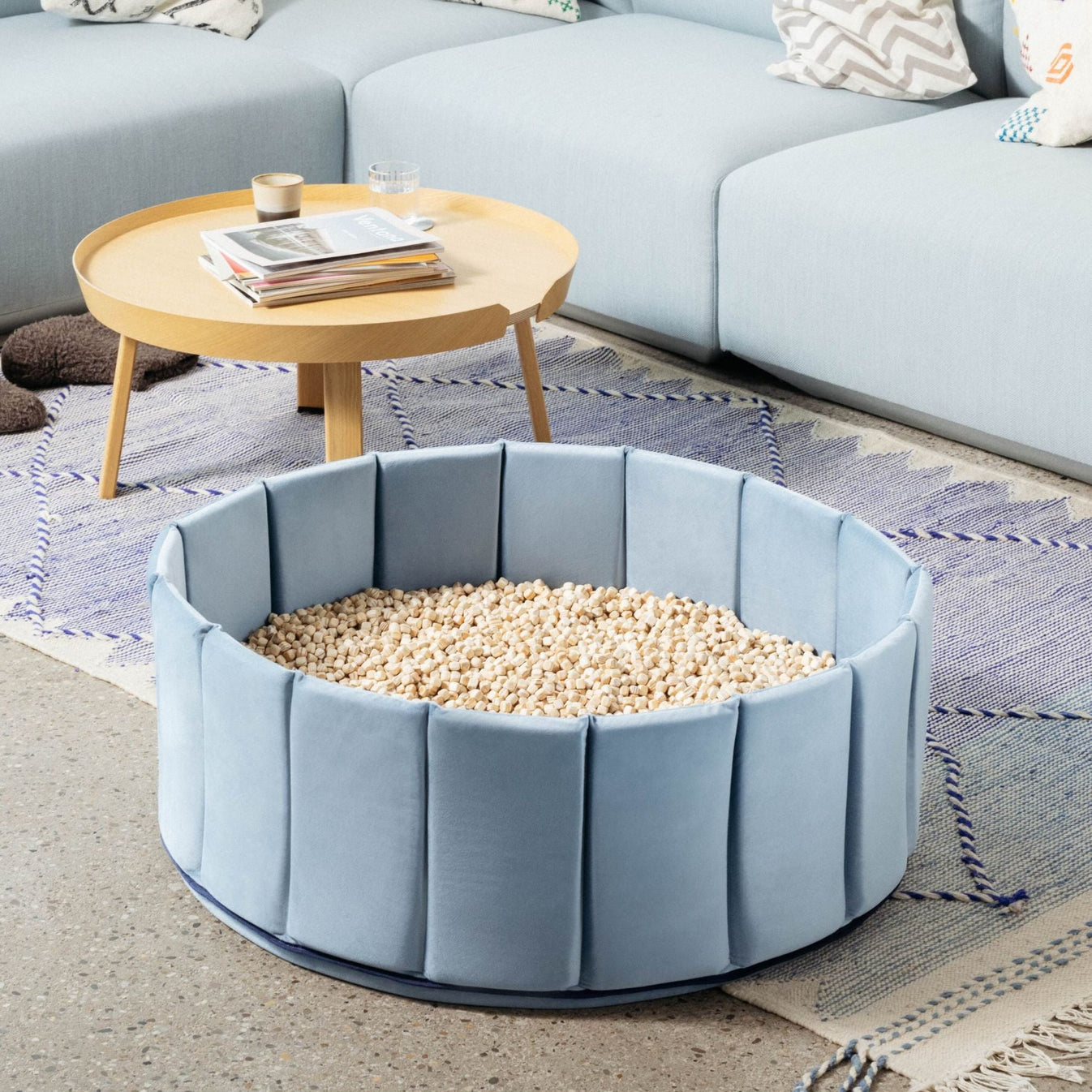
The result: 7,000 larch wood cubes in a foldable velvet basin. Each cube 1x1cm. Untreated. Antibacterial. Indestructible.
"We just wanted to save our own evenings," Julia says today. "The fact that it's now helping more than 1,000 other families in the same way makes us incredibly happy."

The Flowfull® system implements EXACTLY what the study recommends:
1. Multi-sensory activation ✓
- 7-10kg wooden cubes = Proprioceptive input (weight)
- Larch wood texture = Tactile stimulation (touch)
- 1x1cm size = Optimal grasping stimulation (fine motor skills)
2. Balance between structure and freedom ✓
- Velvet basins = Defined boundaries (no chaos)
- 7000+ dice = Endless possibilities (creativity)
- Foldable = Flexible use (can be used anywhere)
3. Sustainable commitment time ✓
- An average of 45 minutes of focused play *
- No lapse in attention
- Daily use without boredom
* Based on customer feedback

Therapists experience the effects daily:
"The children are immersing themselves in the world of the cubes with great joy. We are particularly impressed by the high-quality feel: The Flowfull ® Cubes playfully promote sensorimotor skills, fine motor skills and creativity - at the same time they allow us to work manually in a targeted manner, without the therapy being the main focus."
- Tanja Vorsprach & Katharina Thon, pediatric physiotherapists

Why educators recommend Flowfull®:
"The Flowfull cube pool is a great addition to my parent-child groups. The children explore it with so much curiosity and concentration – wonderful flow moments are created."
- Saskia Wedel, childhood educator

"The children find a safe space here where they can relax, play freely and concentrate fully on their own activities. A play area we would never want to be without again."
- Fabienne Burgy, daycare manager Kitapunkt, Switzerland

Developed with experts – made for life
Flowfull® wasn't created in isolation. From the initial sketch to the final quality check, we were accompanied by occupational therapists , physiotherapists , and educators.
"The sensorimotor cube pool addresses several developmental areas simultaneously - especially motor skills, perception and emotionality - and promotes children's self-efficacy in a playful way."
- Sabine Haller, therapist, Berlin

Science for your home
Over 1,000 families are already using what 144 children in the study proved: multi-sensory play works. When it's done right.
🛡️ Your safety
- ✓ 100-day trial guarantee
- ✓ 2-year product warranty
- ✓ Free shipping
- ✓ Klarna installment payment possible
- ✓ Current special price: €377 only €299
Why Flowfull® is often out of stock:
Each of the 7,000 wooden cubes is made from untreated larch wood. No chemicals. No varnishes. Just pure wood.
This quality, designed for children's hands, comes at a price:
- Extensive handwork in production
- Strict quality controls for every batch
- Only selected woods meet our standards.
Julia and Gil prefer to produce less, but of the highest quality. "We would give it to our children – so you'll get the same."
Secure your set from the current production run
CHECK AVAILABILITYSource: Based on "Beyond play: a comparative study of multi-sensory and traditional toys in child education", Frontiers in Education, February 2024. Study with 144 children, 3-6 years old.

